

Features
The Loggia
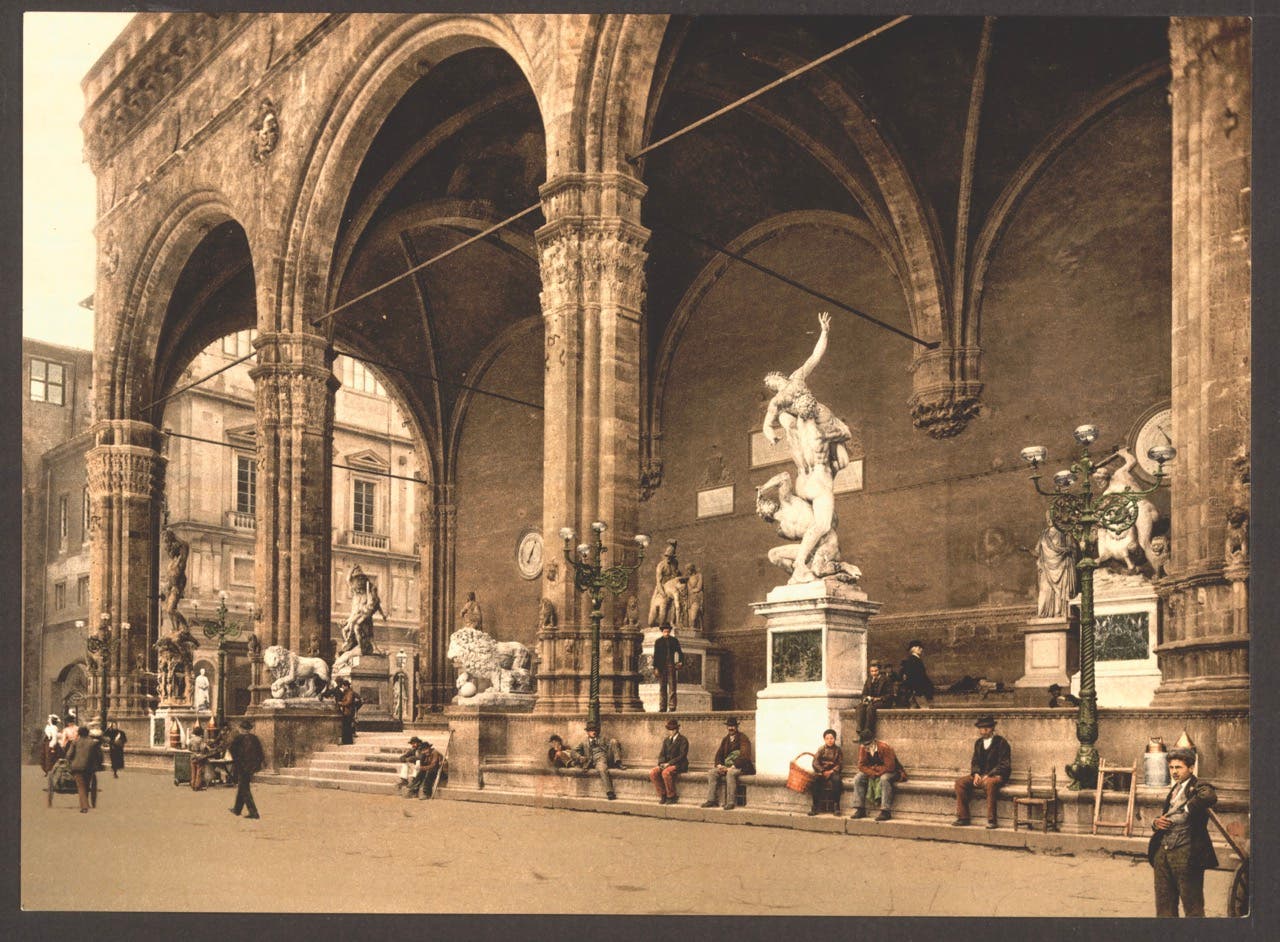
Loggia dei Lanzi, Florence. Photo, 1897. Detroit Publishing Company, Library of Congress.
Italian climate and culture converge in the loggia, an architectural form created for shade and show. A loggia as a central feature of a piazza proclaimed civic virtue; a loggia in a private house served as a place of feasting and fashion. In each case, the form provided shelter from the hot sun and performed a social function, whether for revelry or retreat. Reaching its fullest expression during the Renaissance, architects refined this most august building feature. It is a story of function and fantasy in harmony.
The Loggia dei Lanzi (1376-1382) in the Piazza della Signoria of Florence could claim the role as the preeminent loggia in the crucible of the Renaissance. Its three arches proclaimed the primacy of ancient Roman architecture being rediscovered in this city of rich merchants and bankers. Functionally, it provided a setting for public assemblies and the swearing in of city officers. Between each arch are roundels symbolizing Justice, Fortitude, Temperance, and Prudence, hoped for virtues for governance, not always followed in the tumultuous history of Florence. During the reign of Grand Duke Cosimo Medici I, the loggia housed German mercenary pikemen, gaining it the name of the Loggia of the Lancers (Lanzi in Italian). Besides the aggressive tone set by the mercenaries, the loggia also became a place for the aesthetic appreciation of fine art. Medici lions stand guard at the front steps, and sculptures by Cellini and Giambologna sit under its vaulted ceiling, while ancient Roman statuary lines the back wall.
While city government, whether the Republic or the later Grand Duchy established by the Medici, celebrated itself in the Loggia dei Lanzi, the rich and powerful mercantile families of Florence took the cue and declared their own high status with a loggia, namely the Rucellai, the family that commissioned one directly across from their palace by Leoni Battista Alberti. On a daily basis, the Rucellai loggia (1460) provided shelter for the public; for special occasions it was draped in rich tapestries to serve as the setting for family banquets, all within public view. On June 8, 1466, the loggia fulfilled its truest function: the wedding feast of Bernardo Rucellai and Nannina de Medici, sister of Lorenzo the Magnificent. Two of the most powerful families of Renaissance Florence were joined within a classical loggia.
Not to be outdone by Florence, the Republic of Venice constructed a loggia (1538) in the Piazza di San Marco, at the base of the bell tower and in front of the cathedral of San Marco. It served as the meeting place for Venetian officials in charge of the Treasury of Saint Mark, and guards for the nearby Doge’s Palace also stood watch here. Designed by Jacopo Sansovino, and known as the Loggietto, the structure conjures up the imperial grandeur of the Arch of Constantine in Rome with three arches framed by majestic columns. Above the arches are sculptural reliefs in striking white Istrian stone (from the Istrian region ruled by Venice and now Croatia) depicting the Venetian territories of Crete and Cyprus with Justice in the middle. Bronze figures refer to ancient times in images of Athena, Apollo, Mercury, and Peace filling niches enhanced by slabs of Spartan basalt from Greece. Material richness defines this structure with red marble from Verona and white marble from Carrara embellished with opalescent lumachelle, which sparkles due to its embedded mollusk shells.
Imperial display may have its public grandeur, but the loggia could also be a place of private retreat, especially in that most Renaissance of creations, the country villa. In the hands of the architect Andrea Palladio, the loggia reached its apogee as a focus of a pastoral refuge. Three arches set at the very center of a villa, offering views to green pastures, orchards, and hills, or a river beyond, were the key features of his designs. Born in Vicenza, trained as a stonemason, and then supported by Count Trissino as his patron, Palladio traveled to Rome to view its monuments. Upon his return, he received commissions for palaces in Vicenza and villas in the surrounding countryside, and as his reputation grew, he eventually became architect to the Republic of Venice. Among his early designs in the 1540s are the Villa Pisani at Bagnolo di Lonigo and the Villa Saraceno in Agugliaro. Topped by triangular pediments, but with no monumental columns or excessively carved ornament, these loggias depend on classical proportion and simplicity of line. They stand as minimalist temples to house the noble families of Vicenza and the merchant oligarchs of Venice. Inspired by the pastoral poems of Horace and Virgil, these patrons of villas wished to live like ancient Romans taking their “otium,” contemplative leisure, in a natural paradise, far away from their urban duties, their “neg-otium.” In the cool of the loggia, enlightened occupants could read, write, feast, or simply snooze on a summer afternoon, and they could do so reassured that their pastimes were ennobled by a time-honored form.
The loggia became an icon of civilized living, so much so that it served as an archetype, persisting across the centuries. Palladio’s loggias, published in his Four Books of Architecture (1570), made their way into English translations and adaptation of his designs, such as James Gibbs’ Plate LVIII in his Book of Architecture (1728), which traveled across the globe to land in colonial Virginia as the river facing facade of Mount Airy (1751), the planation house for Colonel John Tayloe II. Vizcaya (1914-1923) in Miami by F. Burrell Hoffman, the Palm Beach houses of Maurice Fatio in the 1920s, and Coco Chanel’s Villa La Pausa (1935) at Roquebrune-Cap-Martin on the French Riviera all have loggias as the focal point of these warm-weather retreats for languid days and party-filled nights. What had been born of function evolved into a setting for fantasy. The true value of the form is in its survival and continual use, whether cloaked in ornament like a triumphal arch or finished in plain stucco as a simplified porch. Thus, the loggia is timeless. TB

Manufacturer of authentic mortise-&-tenon wood shutters: cedar & mahogany, exterior movable & fixed louver, board & batten & raised panel; cutouts, capping, arches & more; hinges & holdbacks; interior louvers, Colonial panels & open frame; painting services; made in USA; family-owned company since 1986; ships nationwide.