

Features
Reliable Sources
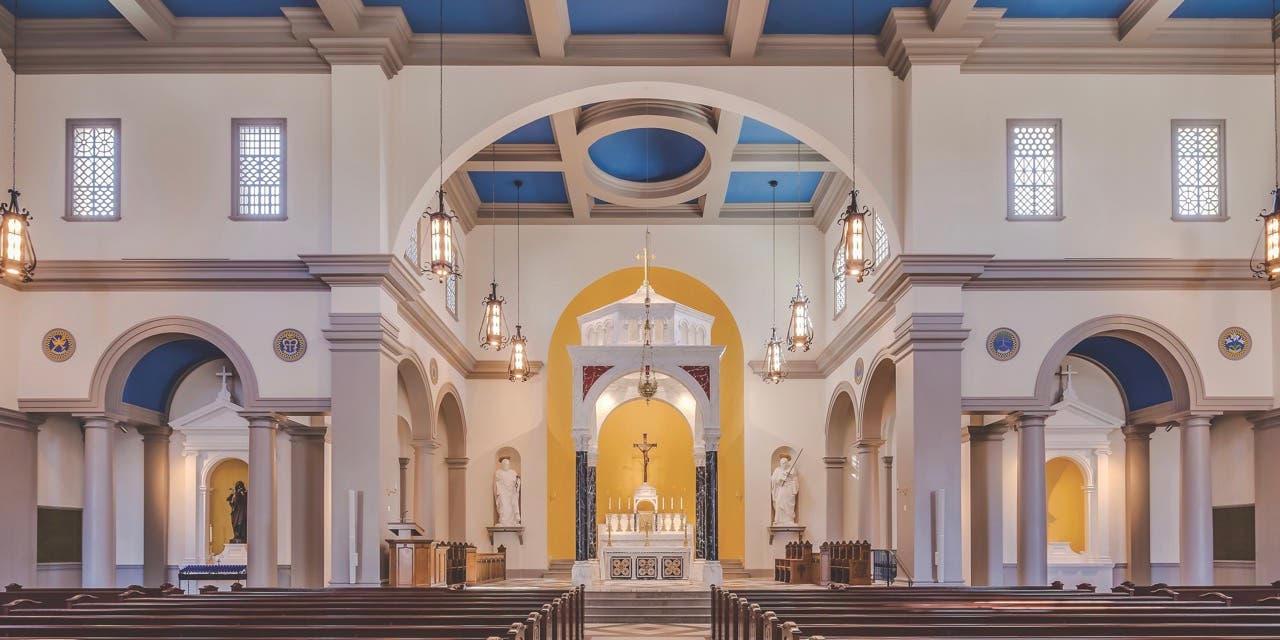
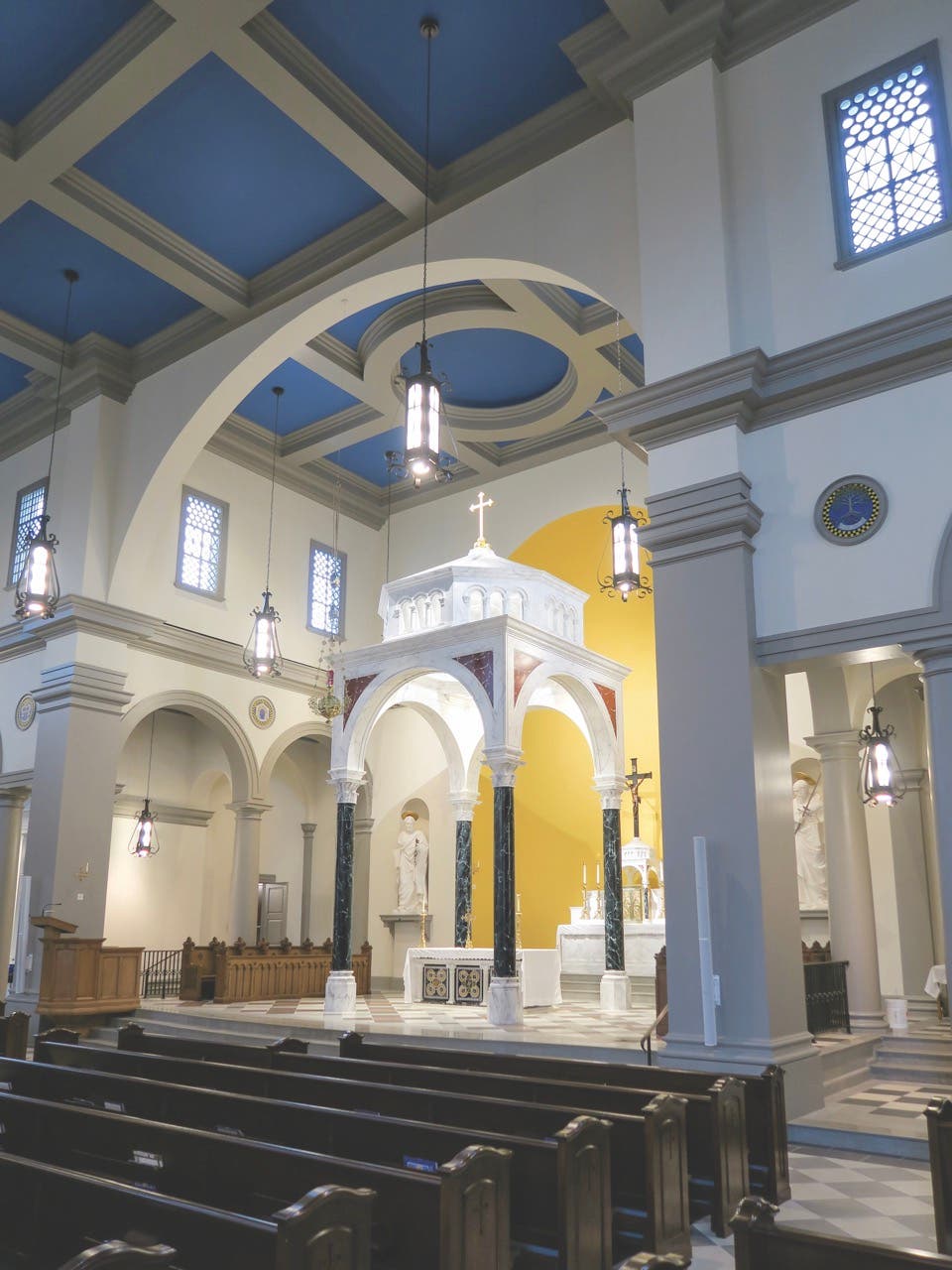
the altar and baldacchino are flanked by two large statues
of St. Peter and St. Paul, since the parish was founded on the feast day of both.
And in Aiken, South Carolina, Father Gregory B. Wilson is a walking, talking example of it.
The former pastor of the newly built St. Mary Help of Christians Church knew the needs of his parish. He knew his architecture too, especially the Romanesque style. And when it came time to build this new Catholic church for Aiken, he knew it had to work within the city’s context.
So he invited Washington D.C. architect James McCrery on a walking tour of Aiken. He wanted to communicate his vision for the church—on foot and at eye level. “I walked through town with the reverend to see all the best buildings in Aiken, so that ours would be the most beautiful,” McCrery says.
It was quite a directive. Aiken was founded in 1835 and soon was known as a retreat for the wealthy residents of Charleston, then for its equestrian-oriented “Winter Colony” of estates built for the likes of New York’s Vanderbilts, Whitneys, and Astors.
The result is a late-nineteenth-century architectural inventory that varies widely, with buildings in the Federal, Greek Revival, Classical Revival, and Victorian styles. The landscape, too, was important: between 1877 and 1900, Aiken planted its “Avenue of Oaks” on South Boundary Avenue. Today, this allée of live oaks is one of the most treasured natural vistas in the city.
Aiken’s Catholic heritage has always been a part of its history. When its 19th-century winter residents–some Catholic, but more Protestant with Catholic servants–arrived, they designed and built a small church for the servant class.
It was far from modest. “It’s a chapel designed by the architect of St. Patrick’s Cathedral,” McCrery says. “It’s a beautiful little jewel box.”
Built for a congregation of 50, it was joined later by a 300-seat church in the Victorian Revival style. Both are sited on a three-block square on the eastern edge of the city, and they presciently left room for a larger, 1,000-seat basilica.
Now, the question was: What style should the new church adopt as its own? Again, the client took the lead, and his architect agreed. “Father Gregory wanted something rooted in the Italian Renaissance—not derivatively from England, but more Roman,” McCrery says. “We both have a strong love of Rome, its architecture and its art.”
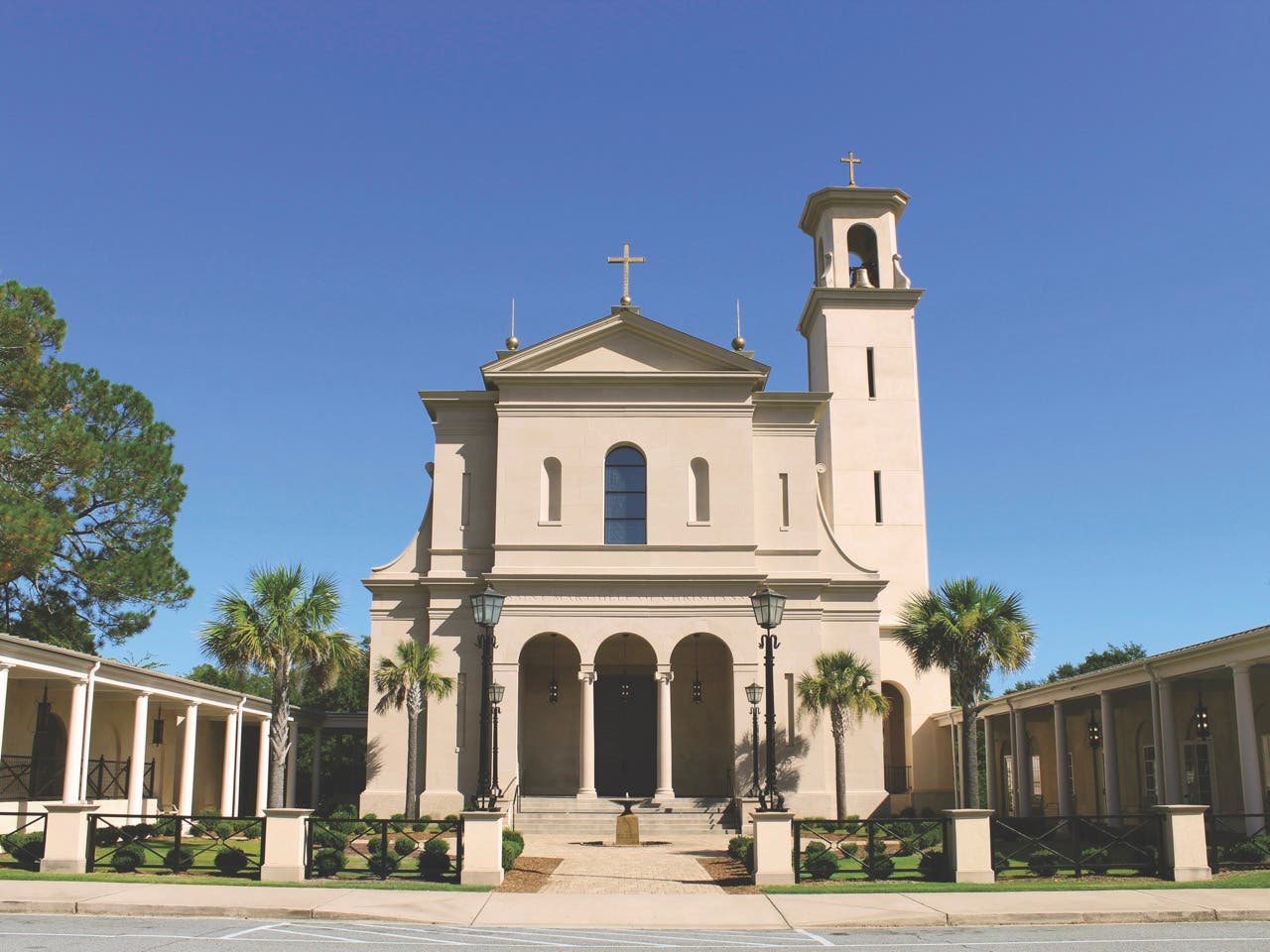
So it was to be Romanesque, with a footprint in the shape of a cross. And it would fit in well with earlier precedents from the Eternal City. “Once finished, it would resemble, on a much smaller scale, the Papal Basilica of St. Paul Outside the Walls in Rome,” Fr. Wilson says. “Its two wings would flank the main entrance, symbolizing the arms of the Mother Church welcoming her people.”

following the form of a classic Roman basilica.
of St. Peter and St. Paul, since the parish was founded on the feast day of both.
architect James McCrery of Washington, D.C.
open space

garden, and then the church itself. “There are four palm trees for the
paradise garden, the Palmetto Tree is the state tree for South Carolina.”
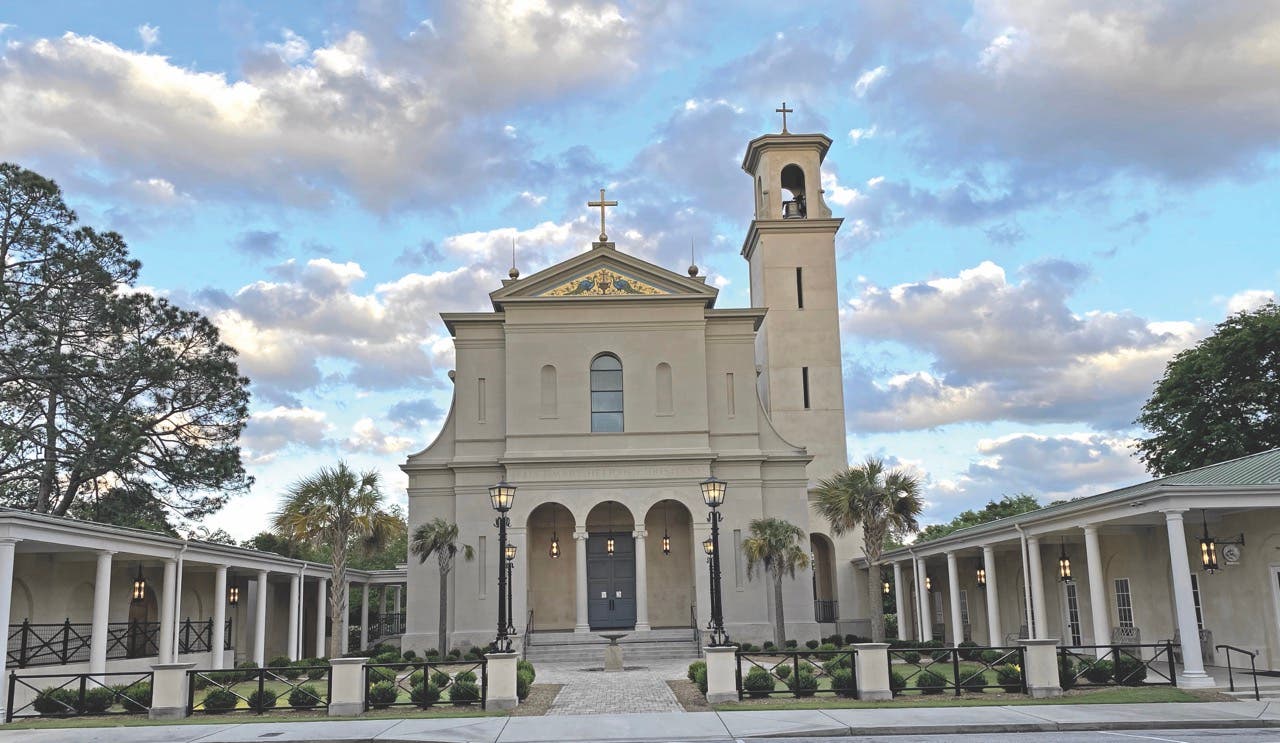
the initial design. Two “wings” flank the main entrance. symbolizing arms of the
Mother Church welcoming her people.
block.

the final design would seat 970.
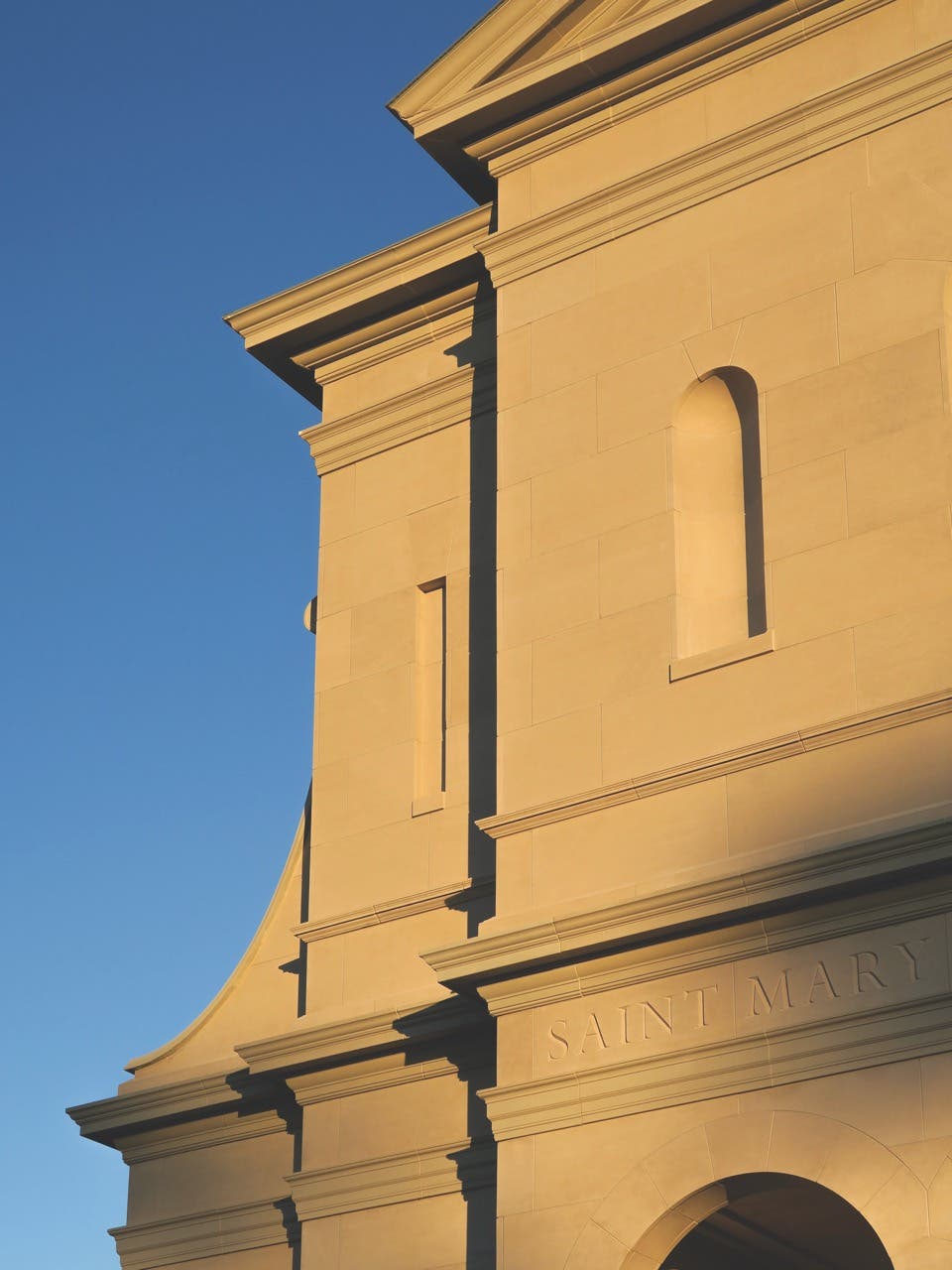
One challenge was an existing concrete block structure used to store charitable foodstuffs. Fr. Wilson wanted it to remain functional, and to shut it down for the shortest time possible while the basilica rose around it, clad in stucco and Indiana limestone.
“The wing on the left side is now a covered colonnade, with a ramp you can push a grocery cart along,” McCrery says. “Then it was necessary to add a wing to the opposite side–for parish hall coffee and donuts, and restrooms.”
The idea of two welcoming wings was championed by a young architect and congregant who proposed it to Fr. Wilson before McCrery was hired. But the D.C. architect embraced it readily. “We took advantage of this young architect with very good ideas, and built around it,” he says.
Next they added a public courtyard—an atrium from the early Christian idea of a forecourt removed from the street. Parishioners first enter that scaled-down garden, and then the church itself. “There are four palm trees for the paradise garden,” he says. “The Palmetto Tree is the state tree for South Carolina.”
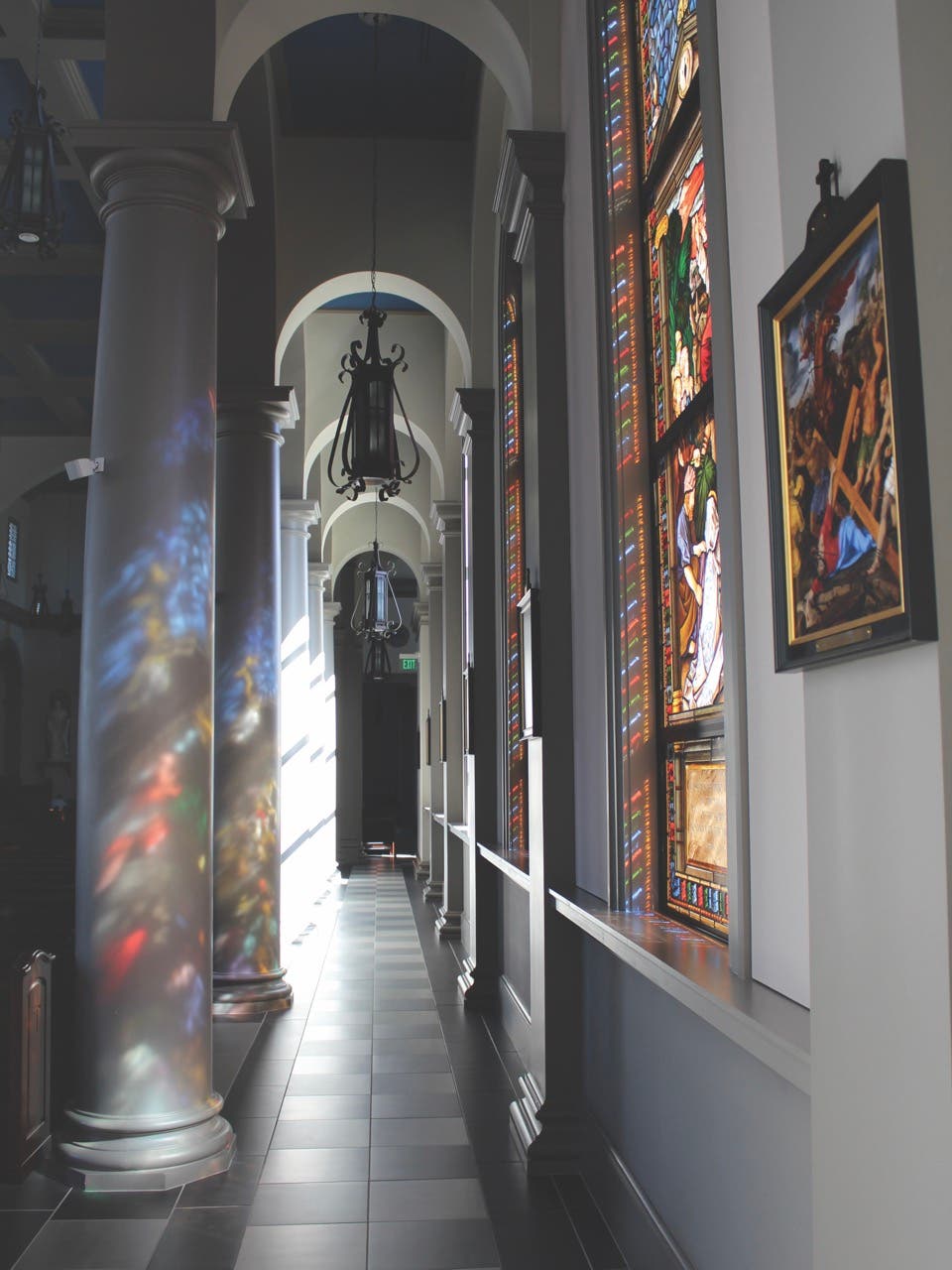
Inside is a canopy, or baldacchino, over the altar–to orient the eye in a large space. A series of side-aisle, stained-glass windows offered parishioners fundraising opportunities to give and be part of the design process.
But one of the most innovative solutions lay with the architect’s plans for the basilica’s clerestory windows. The idea for them came to McCrery while he was visiting Rome and looking at church windows so old they were made of thin sheets of alabaster, rather than glass. Inspired, he sent sketches for panes crafted from plywood back to his contractor in Aiken.
Later, the contractor called him in D.C. “He said ‘The light is pouring down in shafts into the space,’” McCrery says. “You’re getting patterns on the floor from the three-quarter-inch plywood.”
His thin wooden clerestory panels are now permanent fixtures—and a living testament to a harmonious bond between the best clients and their architects. TB
Designer, manufacturer & installer of conservatories, greenhouses, garden follies, pool enclosures, specialty skylights, roof lanterns, domes & garden windows: Classical designs; handcrafted mahogany components; custom designs