

Carroll William Westfall
The Home Above the Shop
OLYMPUS DIGITAL CAMERA
Until recently, the home above the shop was the most common building type worldwide. It resides unnoticed in the parts of cities that have escaped modernist buildings, and it is absent from histories of architecture. It deserves a second chance in today’s new urban areas.
In the first urban settlements people probably lived in buildings that were much like their rural counterparts. As commerce developed so did the home above the shop. As prosperity and population increased within retraining town walls, it was easier to build upward than to increase the perimeter.
While the art of architecture executed the public works, the art building used the vernacular to serve private needs. In ancient Rome the rich and important families had expansive urban residence and country villas while most Romans lived in firetrap high rises above street-front shops. In other cities such as Pompeii the could expand into the rural countryside without having to extend defensive walls.
Today we see there the carefully built and individually distinctive architecture of the public buildings and the much greater extent of the private vernacular residences. They dominate the street frontages the homes of socially and politically important families marked by little more than thresholds and framed portals. Inside, the areas in the front were open to the public for the male proprietor to receive the morning salute that clients paid their patron before following him on his rounds. This ancient form of commuting to work left behind in the women, other family members, domestics, and slaves in the secluded lesser accommodations.
Rome declined with recovery beginning around the year 1000 and settlements began to grow. In Germany the doctrine “Stadtluft macht Frei” conferred the liberties of the town on migrants from the feudal countryside after living within the walls for a year and a day. There and elsewhere the increased population built homes over the shops using rough and ready vernacular construction and ever higher as needed. They contrasted with the well-built castles or manor houses of the landed authorities and with the sacred architecture of the Church’s City of God in these cities of man.
Towns and cities that bought or won a modicum of independence from the landed lords established communal institutions and built buildings for them that were augmented version of their local vernacular. By using an aggrandized version of their local vernacular practices with less expensive materials and craft than the buildings of their landed lords or the Church they were pulling their forelock in the presence of their superiors.
The landed lords and the Church held offices that had descended from ancient laws and traditions, which validated their claims of superiority. While modern social and political histories acknowledge the changes over time to belong to a continuous tradition from antiquity onward, our histories of architecture instead stress the changes as ruptures marked by stylistic changes from era to era. This emphasis on style separates the buildings from their roles in serving political institutions, a void in the narrative that is a counterpart to their neglect of attention to vernacular traditions across time. After all, vernacular buildings lack style.
In the vernacular the differences arise not by the changes that drive styles across time but the regional differences in materials and practices. The differences do not travel far. For example, the town halls and homes above shops vary little from one another within a region but are very different from those at greater distances from one another.
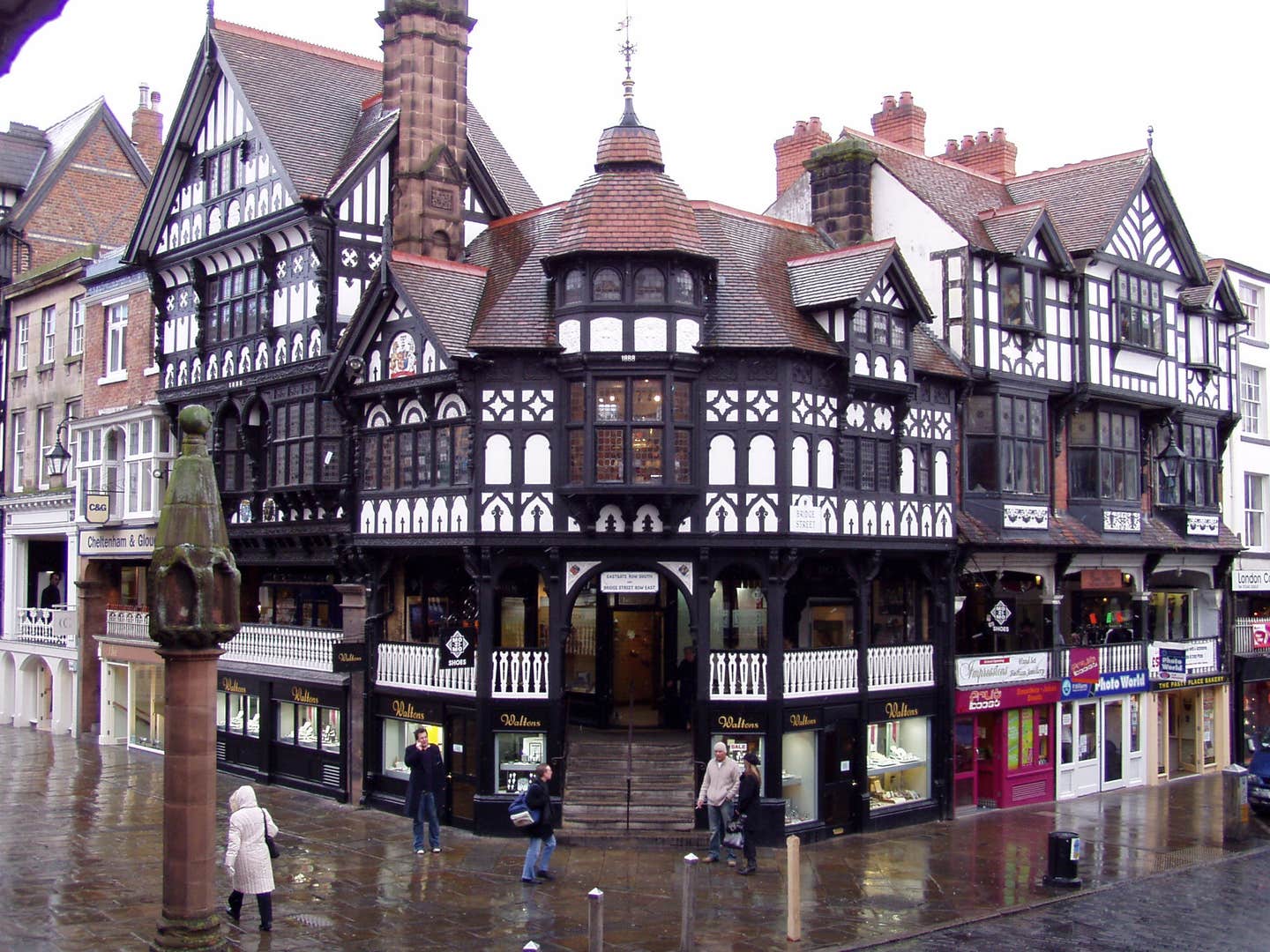
In wooded regions half-timber construction is common. Used since time immemorial, examples abound in popular tourist haunts with multiple stories, as many as six, tucked within their steeply pitched roofs with multiple dormers, and a ganged chimney breaking the silhouette. Their oak frame fastened with pegs often jets beyond the shops on the masonry ground floor and over others higher up, with wattle and daub or brick or stone nogging infill and often with a stucco outer surface.
Chester in England provides an exceptional example from the 13th c.; its upper level of shops were perhaps built on ancient Roman ruins.
For its town hall Alsfeld in Hesse, Germany in 1512-16 elevated vernacular construction to serve the higher rank by deleting the shops, dressing up the front, and adding a bell tower.
In Italy, masonry governed the vernacular ever since antiquity. Most of Rome’s narrow streets have homes above the shops, and they are largely overlooked in Piazza Navona.
In Florence the local stone provided the material for the walls and the buildings that the communal government built for itself. The late 13th c. city hall (Palazzo Vecchio) presents the local, rough faced stone, the same material the town walls and by the principal families for their fortified homes. When the powerful families formed the commune, they lobbed off the tops of their tower homes to a lower height than their new city hall’s and cobbled together family precincts from the remnants. On their fronts they included a large, arched 1 x 3 bay loggia, the shop where they conducted their business with public access to their interior cortile, a continuity with ancient Roman practice but with the private residential quarters not beyond but above.
In 1434 Cosimo de’ Medici commissioned Brunelleschi to design a new family residence on a cleared site, but circumstances intervened, and a decade later he had Michelozzo, now the family’s architect, begin construction on the present palace.
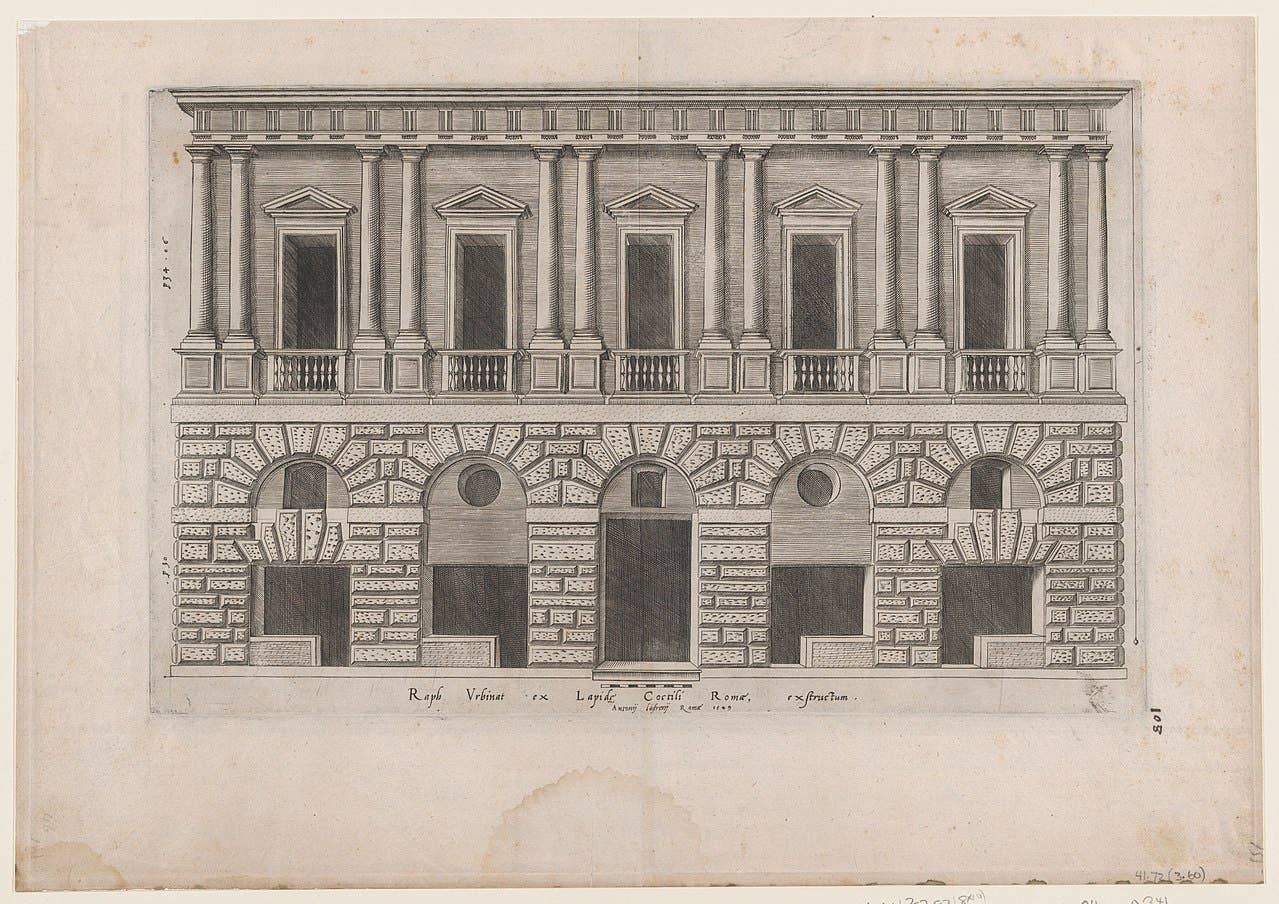
Its ground floor, even more rugged than the city’s walls, had the 1 by 3 loggia followed by the public cortile; above, the two floors of private, family quarters were distinguished by ashlar blocks with surfaces tooled differently on each floor and with other features derived from the new public architecture that was restoring ancient practice. It became the model for many Florentine successors.
As the family’s power in troubled times increased, its safety decreased, and in 1517 they had Michelangelo wall up the loggia. The palace was later refitted for ducal grandeur with the former private door and stair to the residence replaced by a grand stair leading to the piano nobile. It was later sold and enlarged well after a Medici was a duke and had moved into the former city hall and now a ducal residence. In 1540 the family had relocated across the river to the Palazzo Pitti, and soon the duke was commuting to work secluded from his subjects through the Corridor Vasari had built.
In these remote times the shops below the homes were open to the street for business or otherwise closed up with no display of what it offered, but this began to change when glass became more readily available. Cities swelled in population, commerce, industry, and diversity, and the modern city began to appear. Haussmann’s Paris provided an appealing model of a city where residents became commuters. The shops were owned by the residents who lived opulently above and commuted to work elsewhere, as did the inhabitants in the successively more straitened floors above with Puccini’s impecunious “La Bohème” artists in the garret. Glass fronts could display merchandise in closed shops, but masonry construction limited the opening’s size until 1842 when the Boston iron founder Daniel Badger began selling thin cast iron columns and stout lintels that made large ground floor openings below the masonry homes. In New York in 1846 he began making entire, four-story cast iron fronts for buildings serving commercial and manufacturing roles. Workers now lived elsewhere and commuted to work by shanks mare on unpaved, dung-fouled, muddy streets until in New York in 1829 horse drawn omnibuses began operating. Eventually paving was expanded, and other sources for motive power appeared until, in 1888, the electric trolley proved a success in Richmond, Virginia; trolly lines were soon laced through cities everywhere.
Urban areas that traditionally had expanded bit by bit with pedestrian friendly blocks holding houses of different sizes and ages, homes above the shops, churches, and schools.
But after automobiles extended the range for commuting, suburbs developed beyond cities and uncongenial counties or even state laws prevented them from extending their boundaries. Increasingly surrounded by dreary reaches of monocultural zoning that produced ranchburgers and McMansions, their residents commuted along interstates or commerce-lined arterials to work in cities where they paid no real estate taxes to help maintain aging infrastructure, public schools, and social services.
After preservation and gentrification offered some relief, central city areas attracted new multiple story homes above the shop types that contribute to revitalization but were utterly devoid of the residential character necessary for good urbanism.
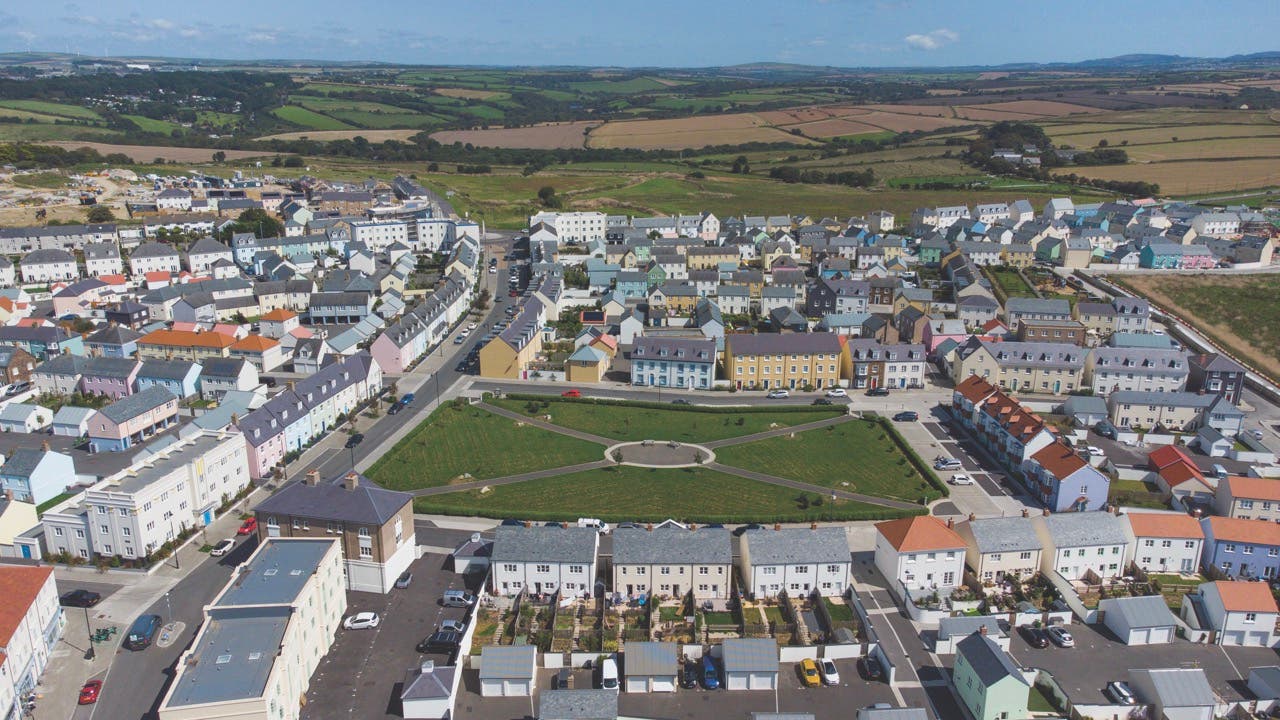
The age-old and very adaptable home above the shop type would be especially attractive to those who “commute” to work via the internet. Various attractive alternatives to suburban sprawl are now being promoted, and the old fashioned version would be a welcome addition.

Carroll William Westfall retired from the University of Notre Dame in 2015 where he taught architectural history and theory since 1998, having earlier taught at Amherst College, the University of Illinois in Chicago, and between 1982 and 1998 at the University of Virginia.
He completed his PhD at Columbia University after his BA from the University of California and MA from the University of Manchester. He has published numerous articles on topics from antiquity to the present day and four books, most recently Architectural Type and Character: A Practical Guide to a History of Architecture coauthored with Samir Younés (Routledge, 2022). His central focus is on the history of the city and the reciprocity between the political life and the urban and architectural elements that serve the common good. He resides in Richmond, Virginia.
Designer, fabricator, finisher & installer of fine quality custom ornamental metalwork for a national market. Products include Stair and balcony railings, fences, gates, custom, metal doors & windows, lighting, grilles, canopies and more. Wiemann is a national sales representatives for Crittall Steel Windows. All cast & wrought-metal alloys, finishes & architectural styles. Since 1940.