


Campus Buildings
Carmichael College: The Final Piece of Vanderbilt’s Living-Learning Vision
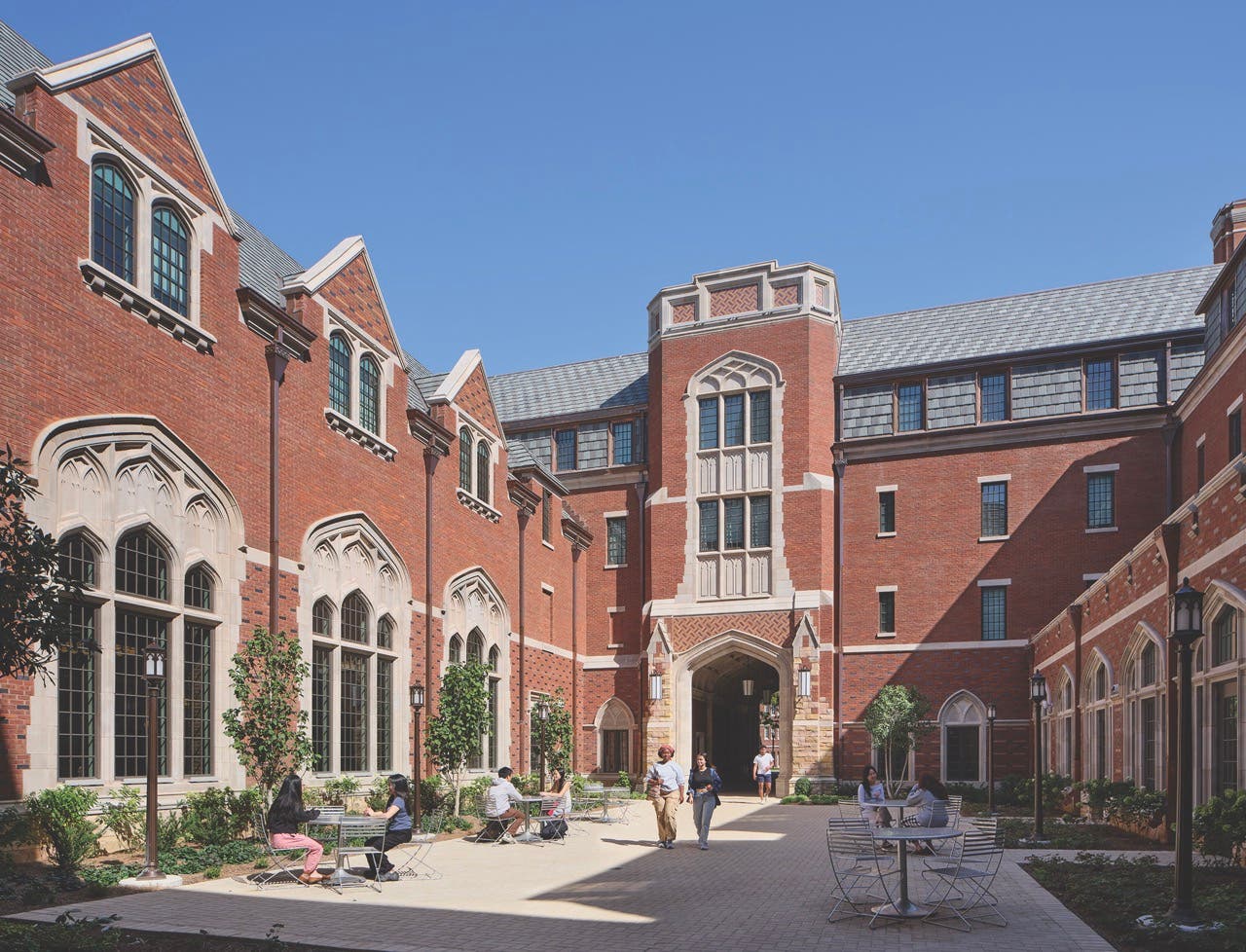
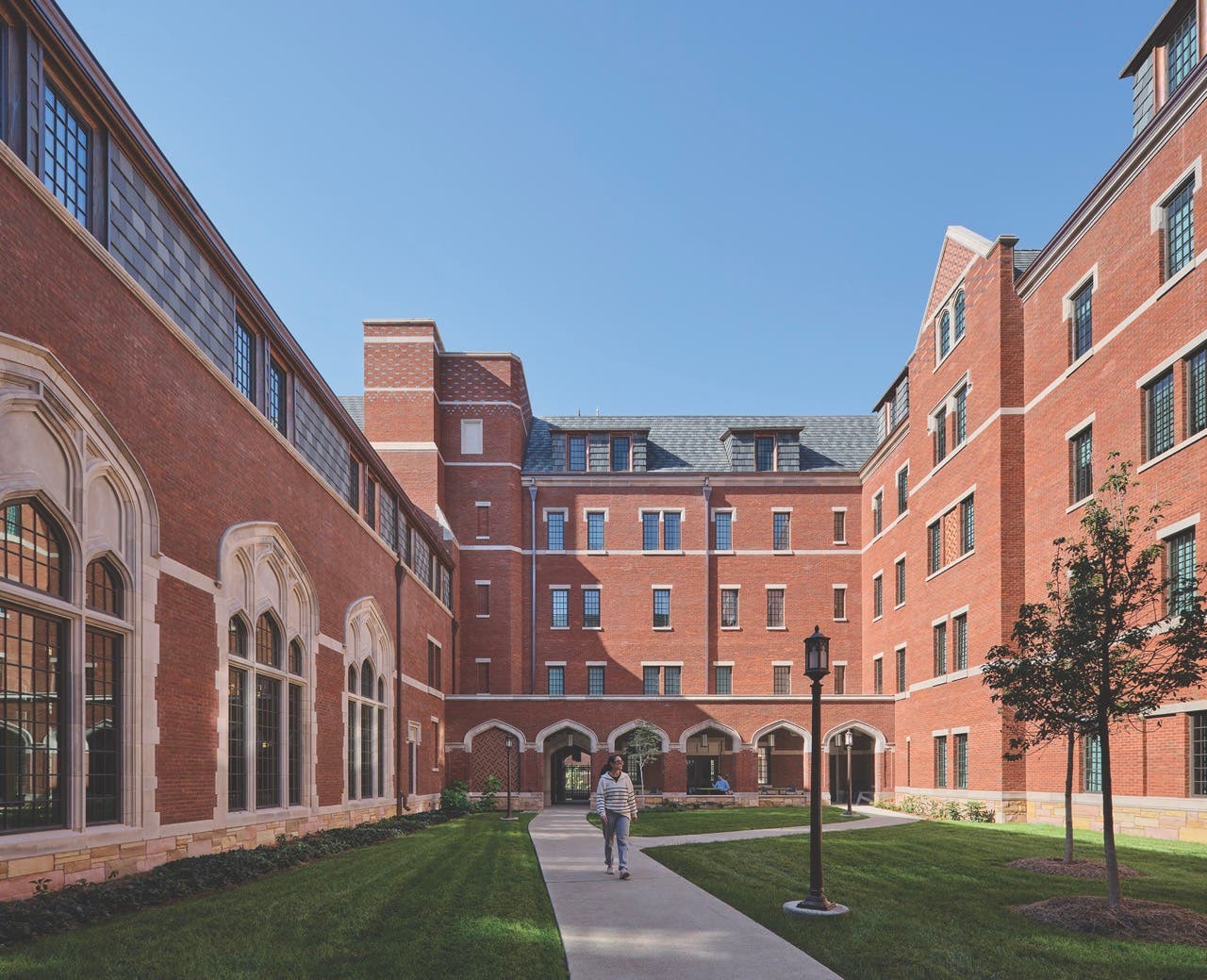
Pulblic courtyard, looking west, connecting to Rothschild College.
The last in a series of four multi-purpose residential colleges built over the past decade on the Vanderbilt campus in Nashville, Oliver C. Carmichael Residential College continues to represent the essence of David M. Schwarz Architects’ original goal for the phased initiative, which was to not only enhance student life but also reflect the university’s commitment to excellence in architecture and environmental stewardship.
“In the early 2000s, when we were originally commissioned by Vanderbilt to help them reimagine the student life experience on campus, they did not really have a clear idea of what they wanted,” explains Steve Knight, principal and managing director at David M. Schwarz Architects. Dated, timeworn dormitory housing from the 1960s didn’t convey the kind of image the university desired, neither inside nor out. “They aspired to something different,” continues the architect, “something that made the student life experience a little more holistic and blurred the lines between living and learning.”
Starting with E. Bronson Ingram College (EBI), completed in 2018, the initiative also includes Nicholas S. Zeppos College (2020) and Rothschild College (2022). To the east of Alumni Lawn, EBI is set apart from the other three, which are adjacent to each other and placed along West End Avenue, a major thoroughfare that connects the western part of the city with downtown. The 160,000-square-foot Carmichael broke ground in 2021 and was completed in May 2024. Situated between Rothschild College to the west and a row of university-owned historic cottages to the east, it serves as a prominent gateway to the public promenade linking the new colleges with the heart of the original campus. “That edge of the campus is highly visible,” says Knight. “In essence, the entire project was an opportunity for Vanderbilt to create a new outward-facing image.”
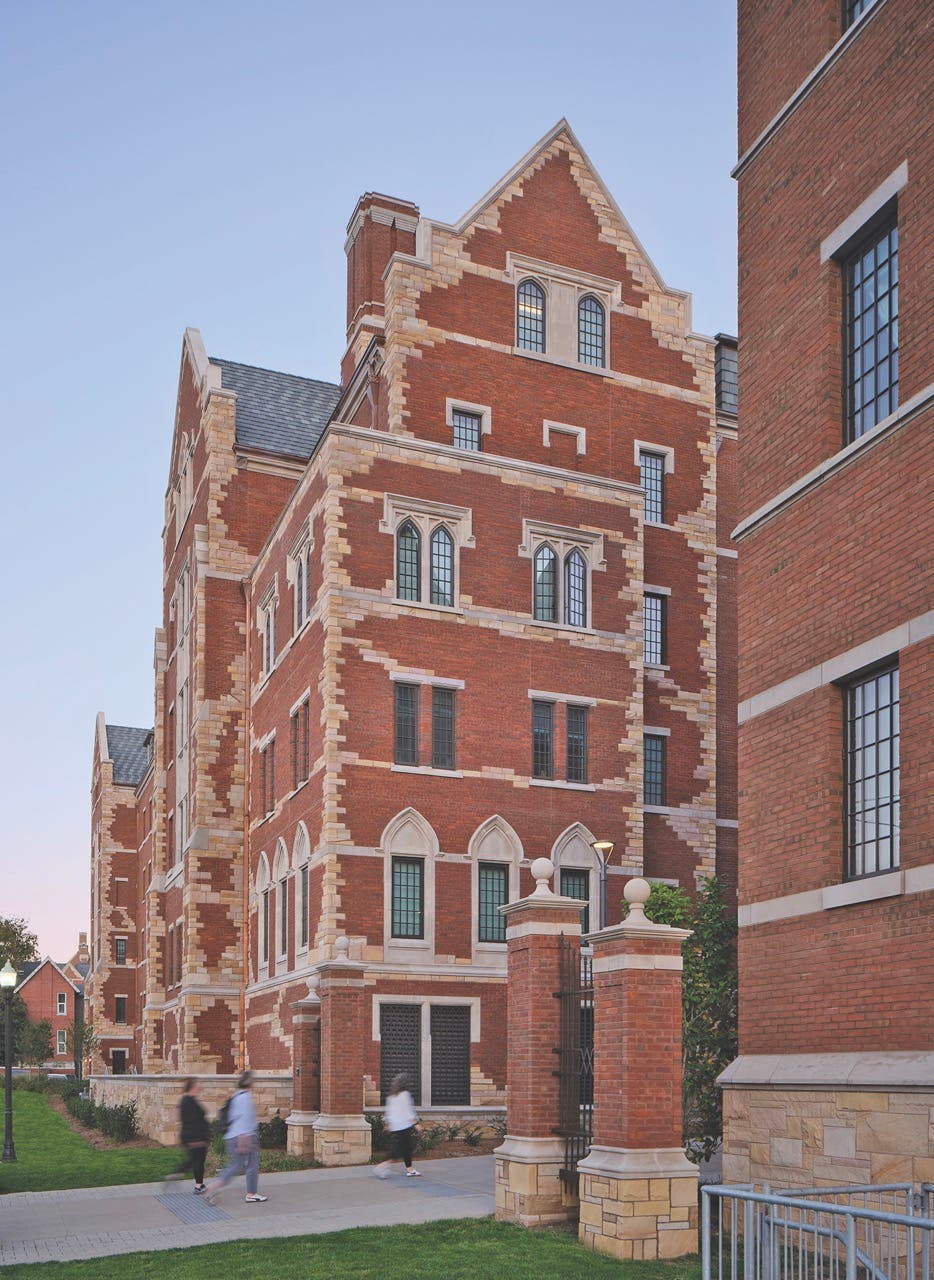
Carmichael College, left, and Rothschild, right.
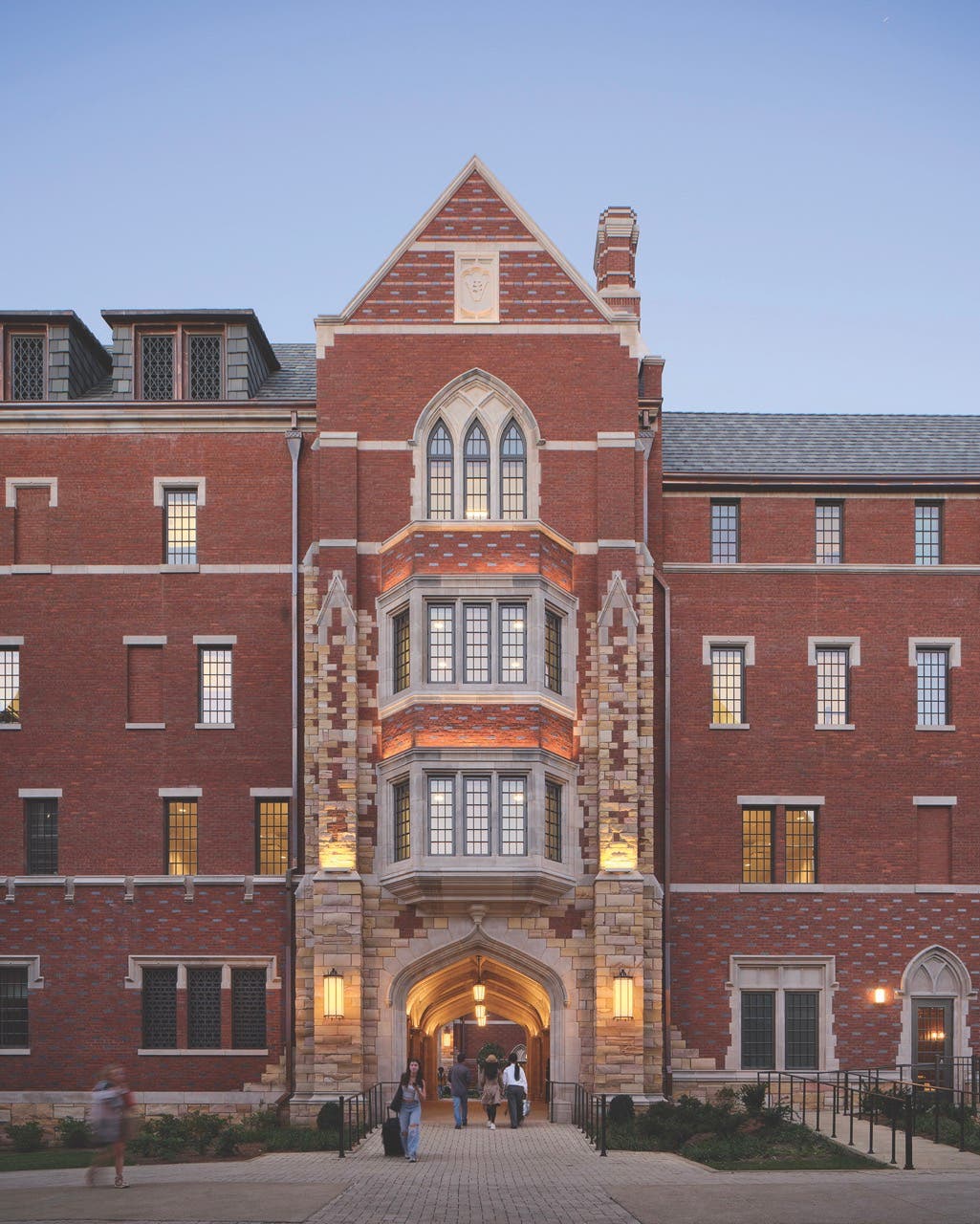
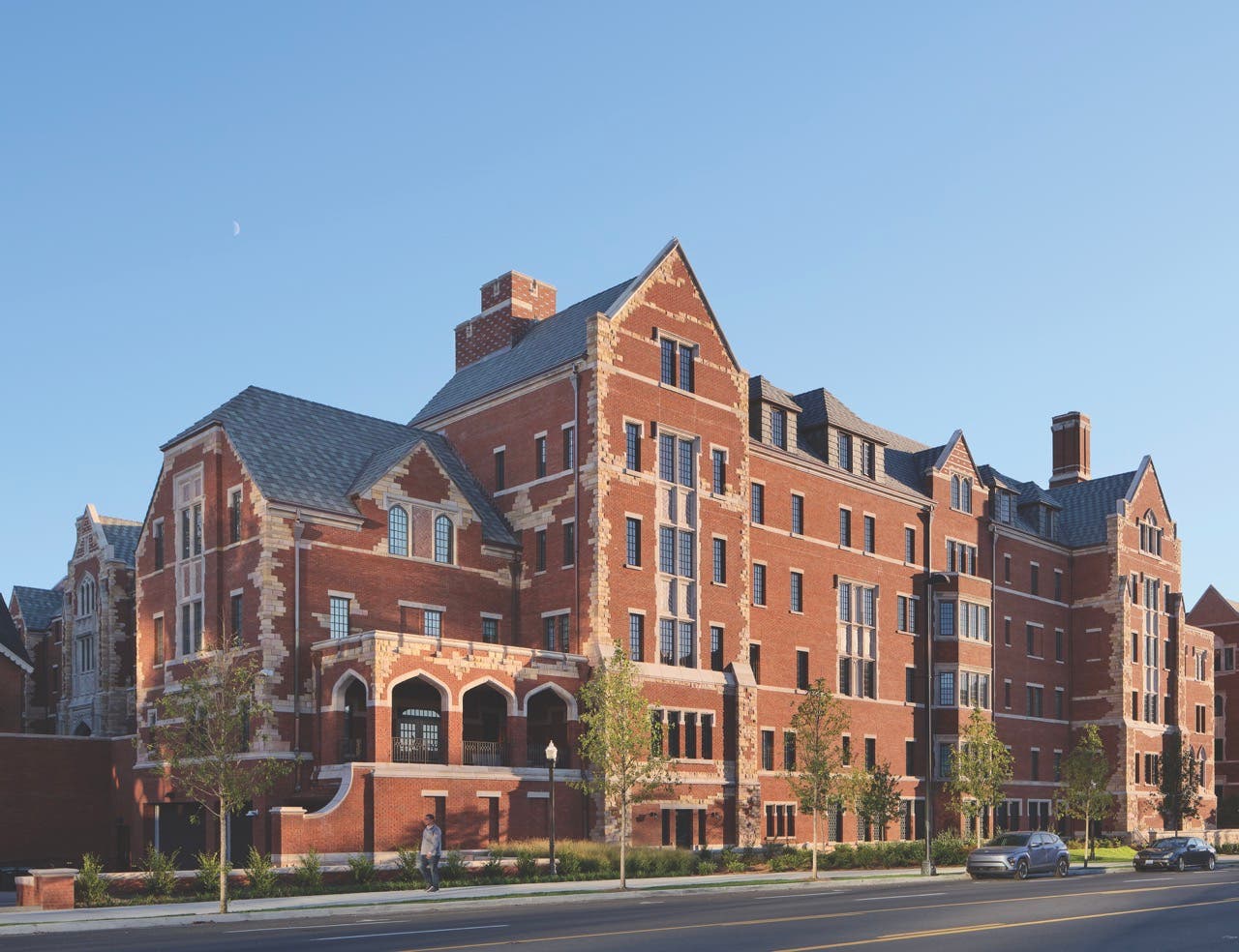
three to five stories to reflect the historic context.
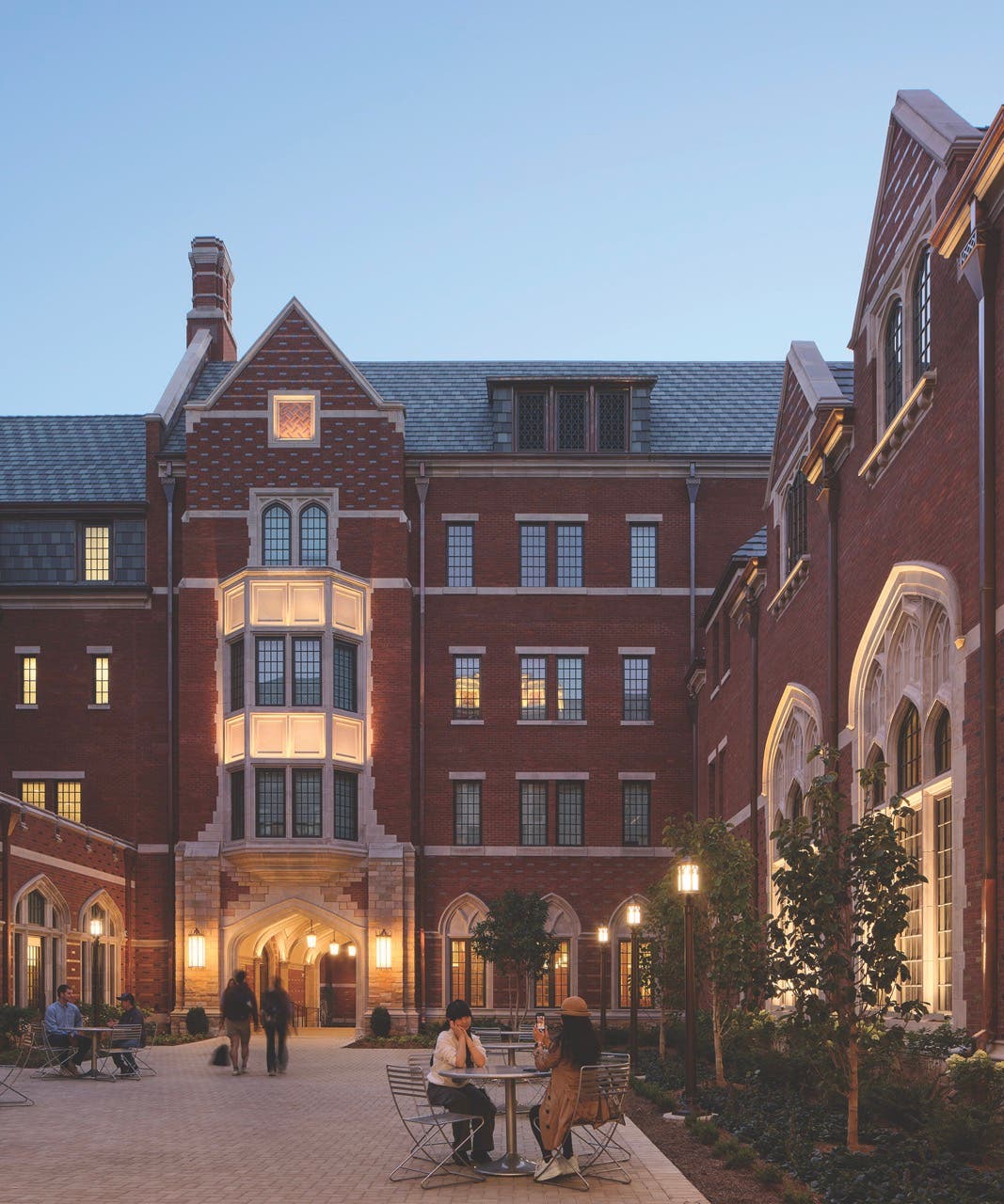
looking toward the west portal connecting
Carmichael College to Rothschild College.
Like its three predecessors, Carmichael College employs a Collegiate Gothic vernacular incorporating a mixed palette of traditional materials such as brick, Indiana limestone, and Tennessee crab orchard stone, which is native to the region and used as an accent material. But, notes Knight, “each of the four colleges is subtly different from the others, which was very intentional. We wanted to create a unified whole, but we also wanted to make sure that each one had its own unique expression.” Carmichael, on the exterior, is a bit of a merger of polychromatic brickwork and heavier, decorative stonework; it borrows a little from each.
The facade incorporates some elements from Gothic architecture, such as pointed arches and narrowly proportioned casement-style windows. A distinct tower at the building’s eastern entry signifies the terminus of the promenade, while a grand staircase on the western elevation breaks up the facade and provides visual interest. It is five-stories except for on the east side, where the scale steps down to 3.5 stories in order to be more compatible aesthetically with a row of five 1.5-story brick cottages dating to the late 1800s that Vanderbilt uses largely for administrative offices and student organizations.
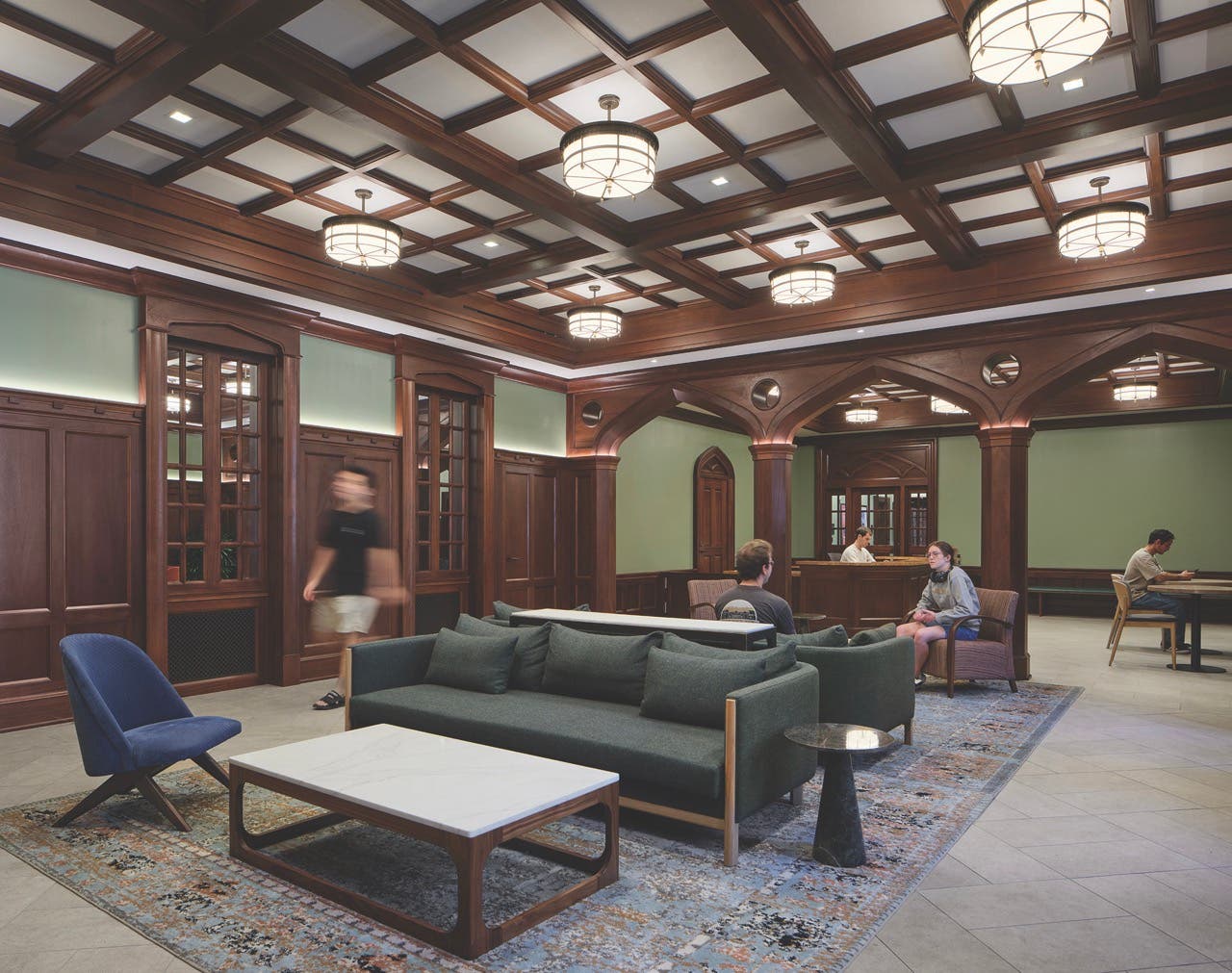
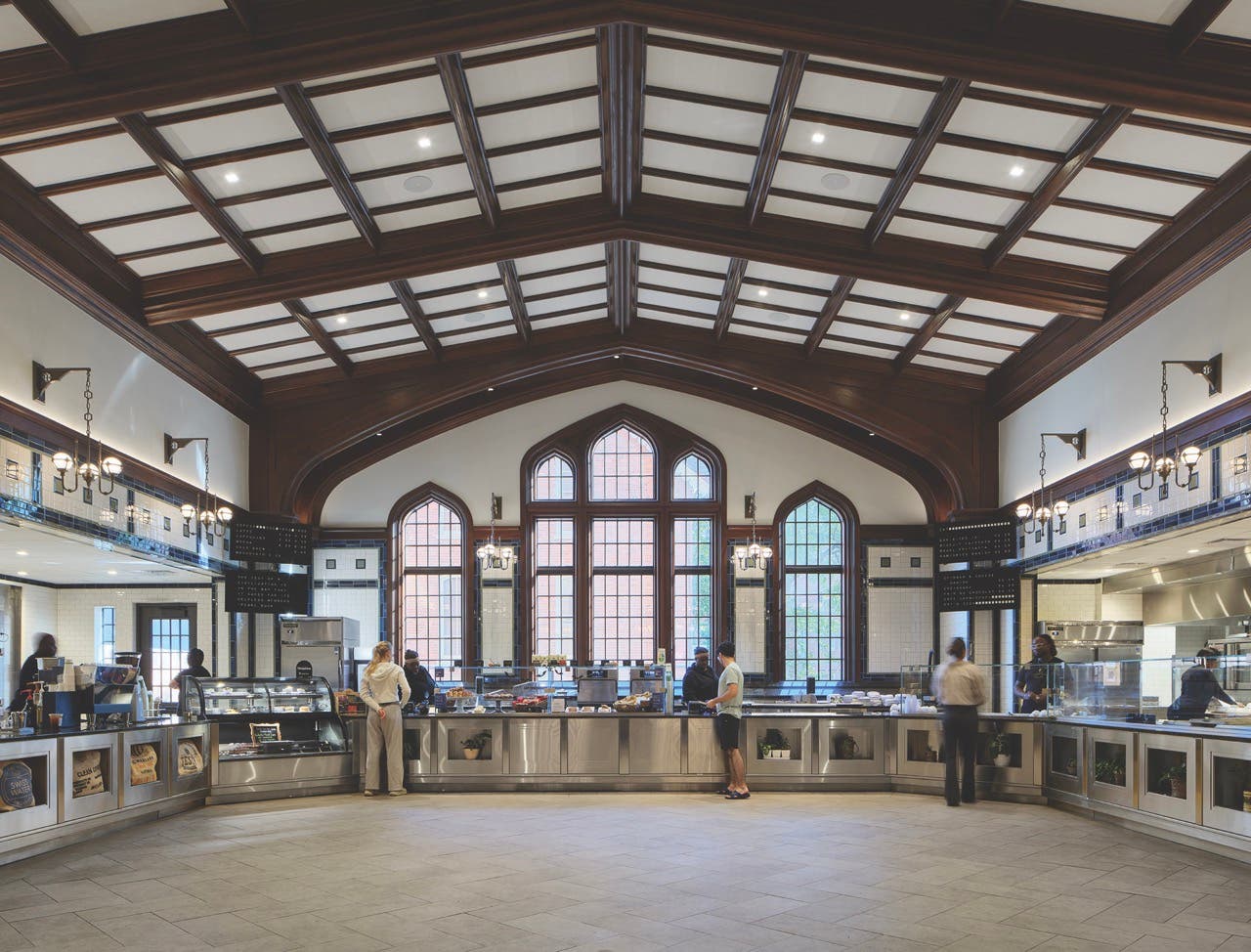
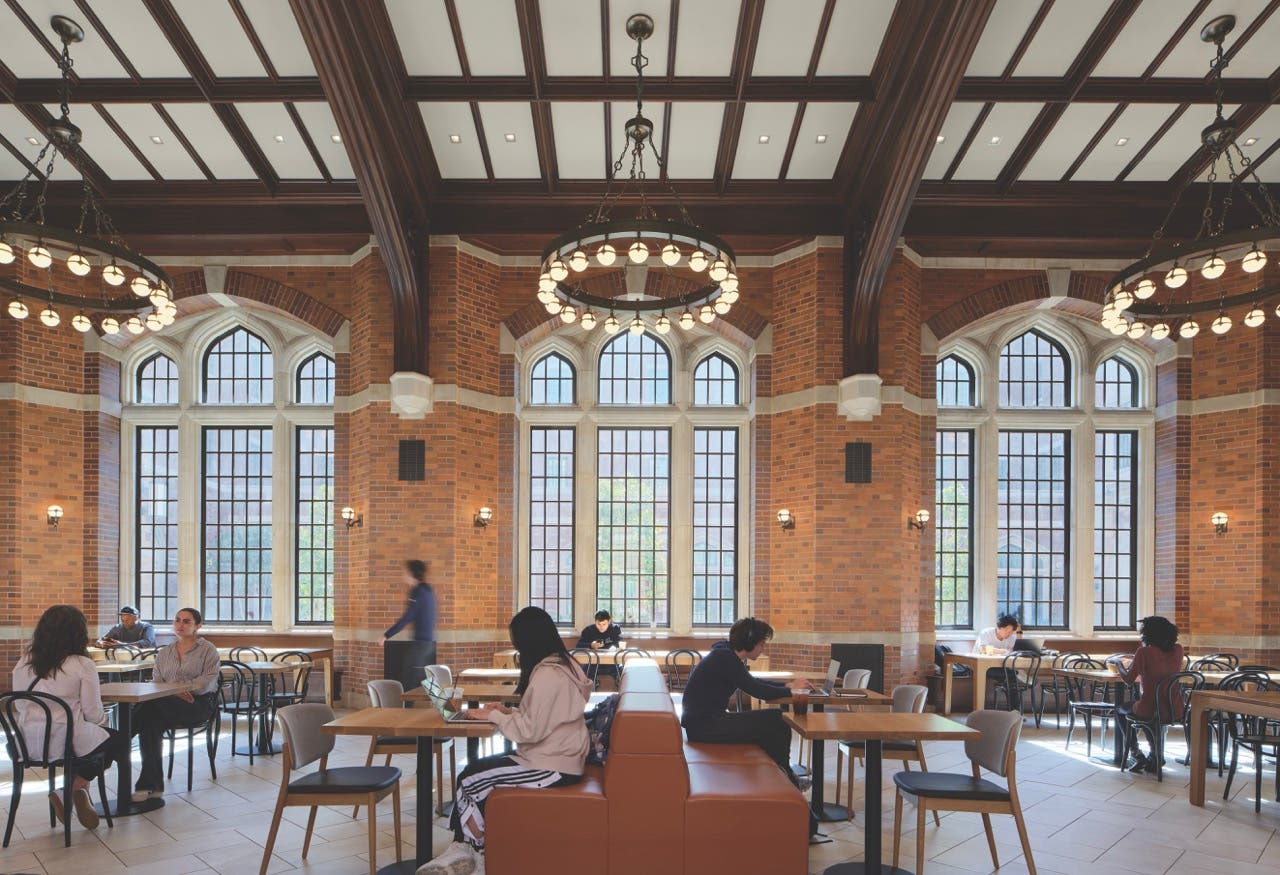
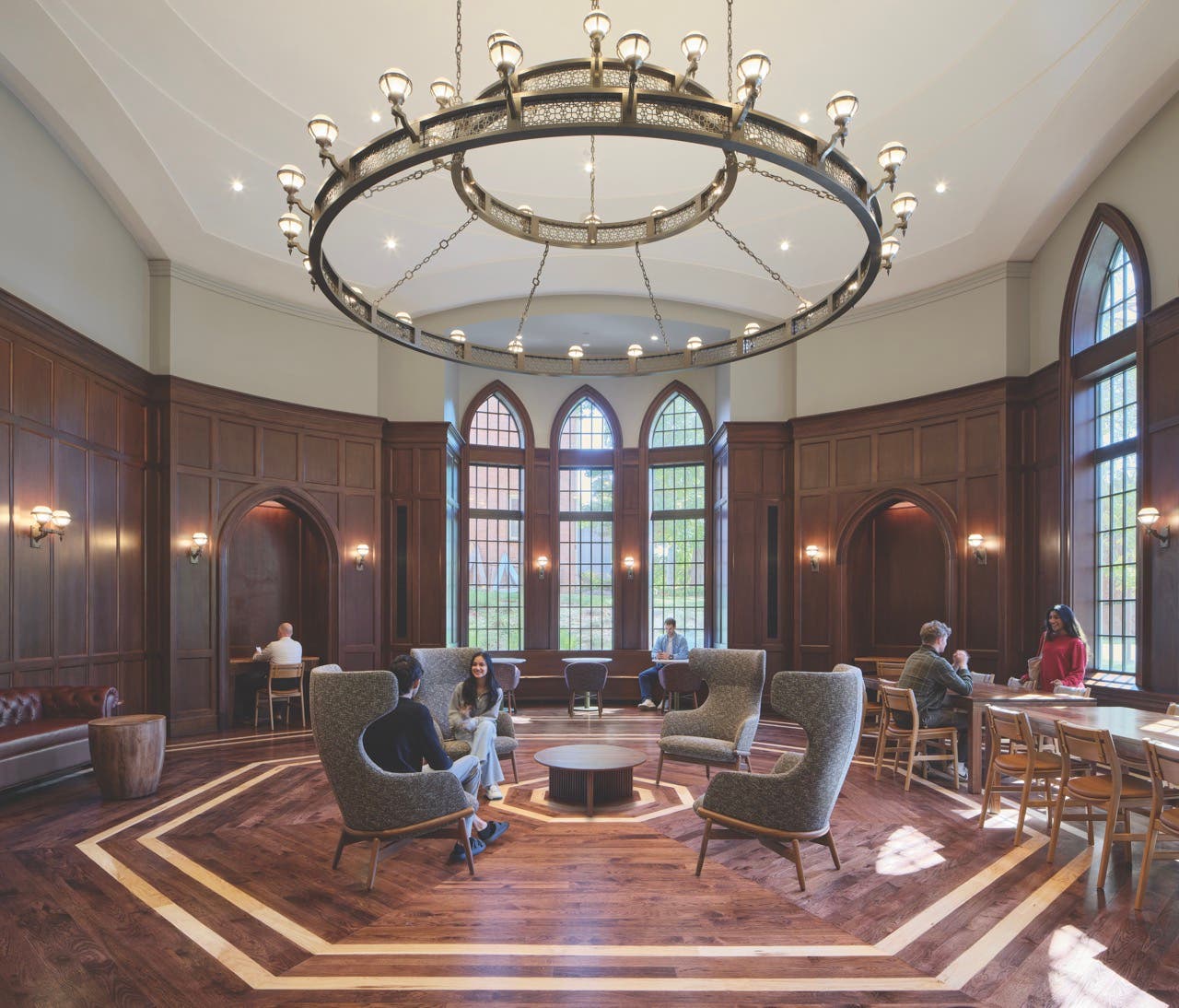
Interiors, says Knight, are a place where Carmichael distinguishes itself even more than the other three colleges. Throughout the public areas, carefully crafted millwork and durable, high-quality materials connect the interior spaces to Vanderbilt’s storied architectural tradition.
“We were very interested in taking the palette of masonry materials typically found on the exterior of modern buildings and bringing them to the interior.” In the dining room, for example, the walls are brick and stone and there’s a pitched ceiling of wood trusses. Enhancing its role as a warm and inviting hub for student interaction, large windows flood the space with natural light. This distinctive room (which remind many of Hogwarts) is centrally located between two landscaped courtyards, one is private and only accessible to student residents; the other is public and connects with the promenade.
In addition to being visually stunning, the dining room represents one of the phased initiative’s prevailing challenges, namely, says Knight, “how to resolve the desired architectural expression—a complex and rich palette of materials with very intricate details—with modern methods of construction and even material procurement.” He credits his team and Hastings, the architect of record, for together figuring out how to resolve the look of monolithic masonry, inside and out, with industry and state-of-the-art standards for general comforts like air-conditioning. “We had the freedom to develop the right aesthetic expression, the material palette, and we had a really competent team of professionals.”
Escalating costs between 2014 and 2024 were a challenge that Knight and his team addressed in resourceful ways. Initially designed as a rectangle, for example, the Great Room was reduced to a square with a dome-shaped ceiling, a decision that maintained architectural grandeur while also aligning with budgetary goals. A similar strategy applied to focusing the detail and the use of more decorative elements in places that were more visible than others.
“Our thinking evolved quite a bit from our first college to the last, in terms of being more strategic with the placement of details and developing details that could be a little more cost-effective than they would have been otherwise,” says Knight. What didn’t change, and what Carmichael College brings to a crescendo, is the elevation of Vanderbilt’s residential offerings along with its reinforcement of a strong sense of community, tradition, and continuity within an ever-developing architectural landscape. TB

Janice Randall Rohlf is a freelance writer who lives on Cape Cod, and is the former editor of Cape Cod View magazine for the Cape Cod Times.

Manufacturer of handcrafted solid-bronze architectural hardware: door, window, bath, sink & cabinet hardware & kitchen accessories; 7 different finishes; traditional, contemporary & other styles.