

Peter Miller
Tusks, Taxidermy, TR: Worth a Visit
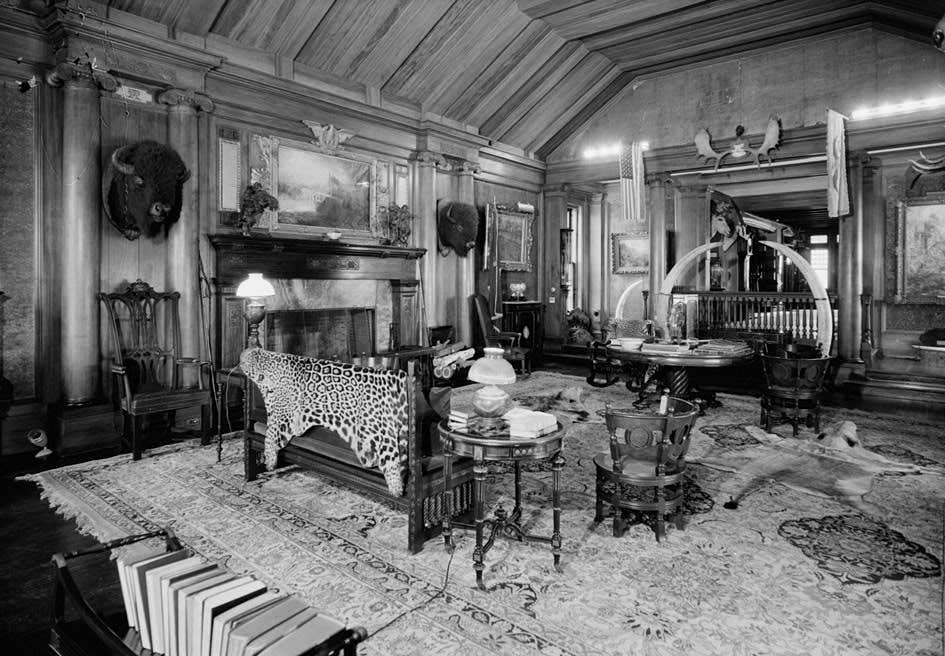
Mounted on nearly every wall, heads of Cape buffalo and elk and elephant tusks dominate historic rooms at Sagamore Hill, a National Historic Site managed by the National Park Service. This is the home of Theodore Roosevelt, our 26th President, a proud “great white hunter” of his time. (He named the house using the Algonquin word for chieftain.) Roosevelt’s interest in taxidermy dated to his childhood spent hunting birds and squirrels in the woods around Oyster Bay on New York’s Long Island. At age ten, he was a do-it-yourself taxidermist.
When he was 22 years old, Roosevelt commissioned New York City architects Lamb & Rich (1880–99) to design his 22-room Queen Anne/Shingle Style summer house atop a 155-acre working farm. Sagamore Hill was built in 1884–85 at a cost of $16,975. Other Lamb & Rich works include Copshaholm, home of South Bend, Indiana, industrialist James Oliver, and the main buildings at both Barnard College and Pratt Institute.
Roosevelt had an addition built in 1905: the “north room,” the largest in the house at 40’ x 30’. He extended the front porch to the southwest, making room for a podium from which he gave speeches to audiences on the lawn below.
The house was most recently restored between 2009 and 2015 by a National Park Service team led by curator Susan Sarna. Ten million dollars later, after meticulous research and careful restoration of the house’s contents, Sagamore Hill has reopened to the public. The restoration polished 12,000 of Roosevelt’s personal possessions and an additional 8,000 books. The wallpaper chosen by his second wife Edith also was restored. Renovation included 98 new windows, woodwork repairs, a new roof and new shutters, and a new airshaft, boiler, and electrical wiring. Roosevelt would approve, as most of the house remains as he built it.
Roosevelt loved Sagamore Hill, where he and his wife raised six children as well as ponies, chickens, cows, and goats. It was his “summer White House” where foreign dignitaries were received and treaties signed. Most of all, though it is a home, grand and yet cozy, important but relaxed. Roosevelt wrote of Sagamore Hill:
“We have great fireplaces and in them the logs roar and crackle during the long winter evenings. The big piazza is for the hot-still afternoons of summer…There could be no healthier and pleasanter place in which to bring up children than in that nook of old-time America around Sagamore Hill.”
The first floor has an entry hall, a library (TR’s study), a drawing room (Edith’s study); a dining room, and a pantry and kitchen. Family bedrooms occupy the second floor and servant’s quarters are on the third. A sunny upstairs porch opens off the master bedroom.
You can book reservations to tour the house in advance at recreation.gov, or buy same-day tickets at the visitor center for $10. The Sagamore Hill grounds are open sunrise to sunset. A nature trail winds down the hill from the Old Orchard Museum to a pretty cove in Cold Spring Harbor.

Manufacturer of handcrafted solid-bronze architectural hardware: door, window, bath, sink & cabinet hardware & kitchen accessories; 7 different finishes; traditional, contemporary & other styles.