

Windows & Doors
Historic Replication
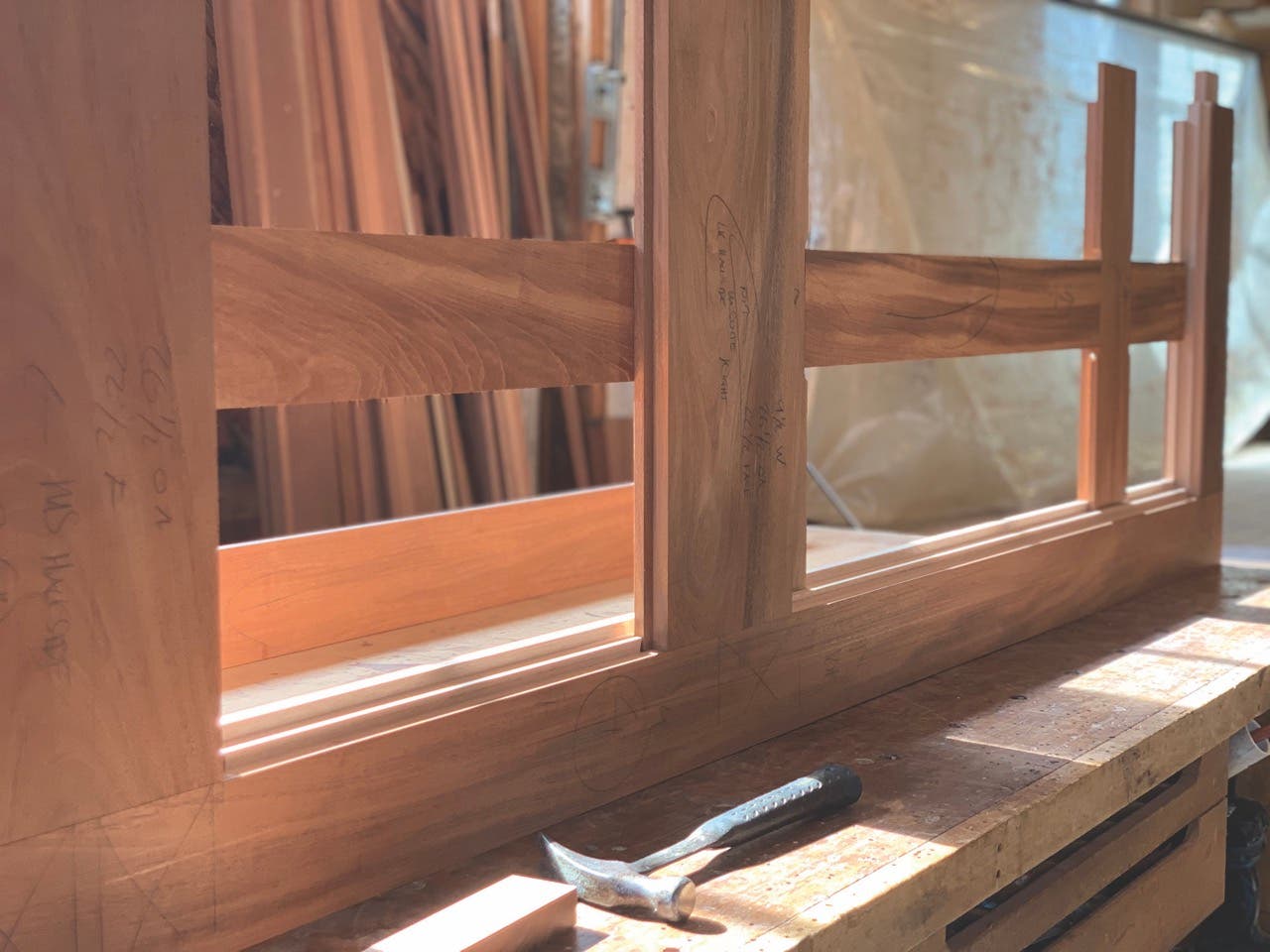
A view during construction showing the dry-
fitting of frame components prior to assembly. This
was done to ensure all joinery was in order before
permanent assembly. The photo also reveals some of
the inner workings of the door needed to achieve the
distinct elevations.
It was a project promising sky-high levels of grandeur, and requiring a dizzying degree of complexity. Portledge, a 1910 estate in Bryn Mawr, Pennsylvania, designed by celebrated architect Horace Trumbauer, was undergoing a painstaking historic restoration, and the interior needed 14 doors to complement the surviving originals. More than half were exact replicas; all were made from gorgeous bookmatched Honduran mahogany, each featuring hyper-specific elevations and profiles.
After the homeowner asked Historic Doors LLC—a custom woodworking shop in Southeastern Pennsylvania that has specialized in wooden doors, traditional joinery, and granular detail since its start in 1981—Mark Hendricks felt a fondness for the project even before stepping onto the job site. “I studied classical architecture, and [Trumbauer] is one of my heroes in that sense,” says Hendricks, project manager at Historic Doors. Meanwhile, the client’s uncommon dedication to hewing to precedent made for a rare, welcome partnership. “It’s a wonderful opportunity when you have someone who’s committed, who wants us to just not hold back in any way,” Hendricks says.
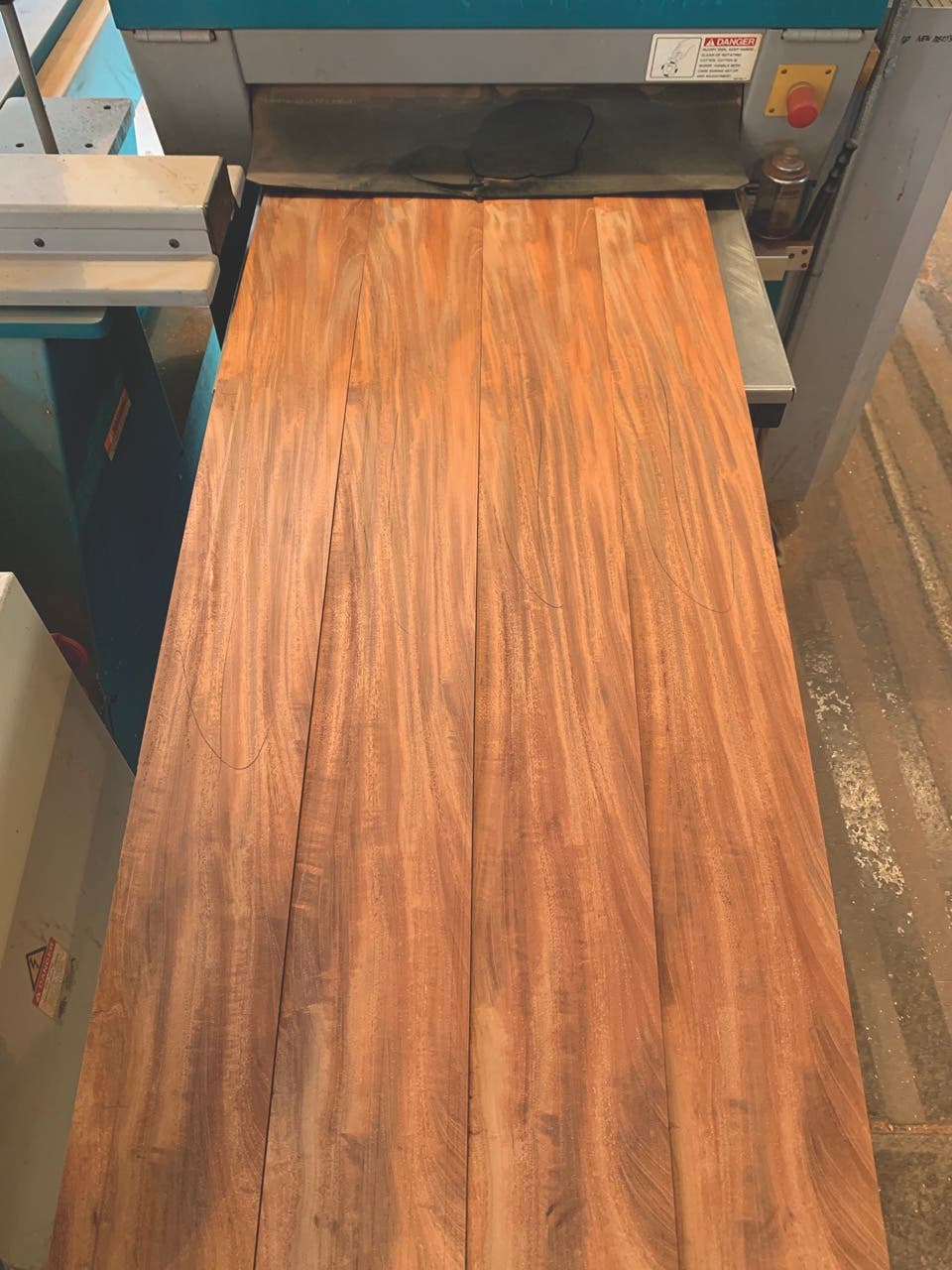
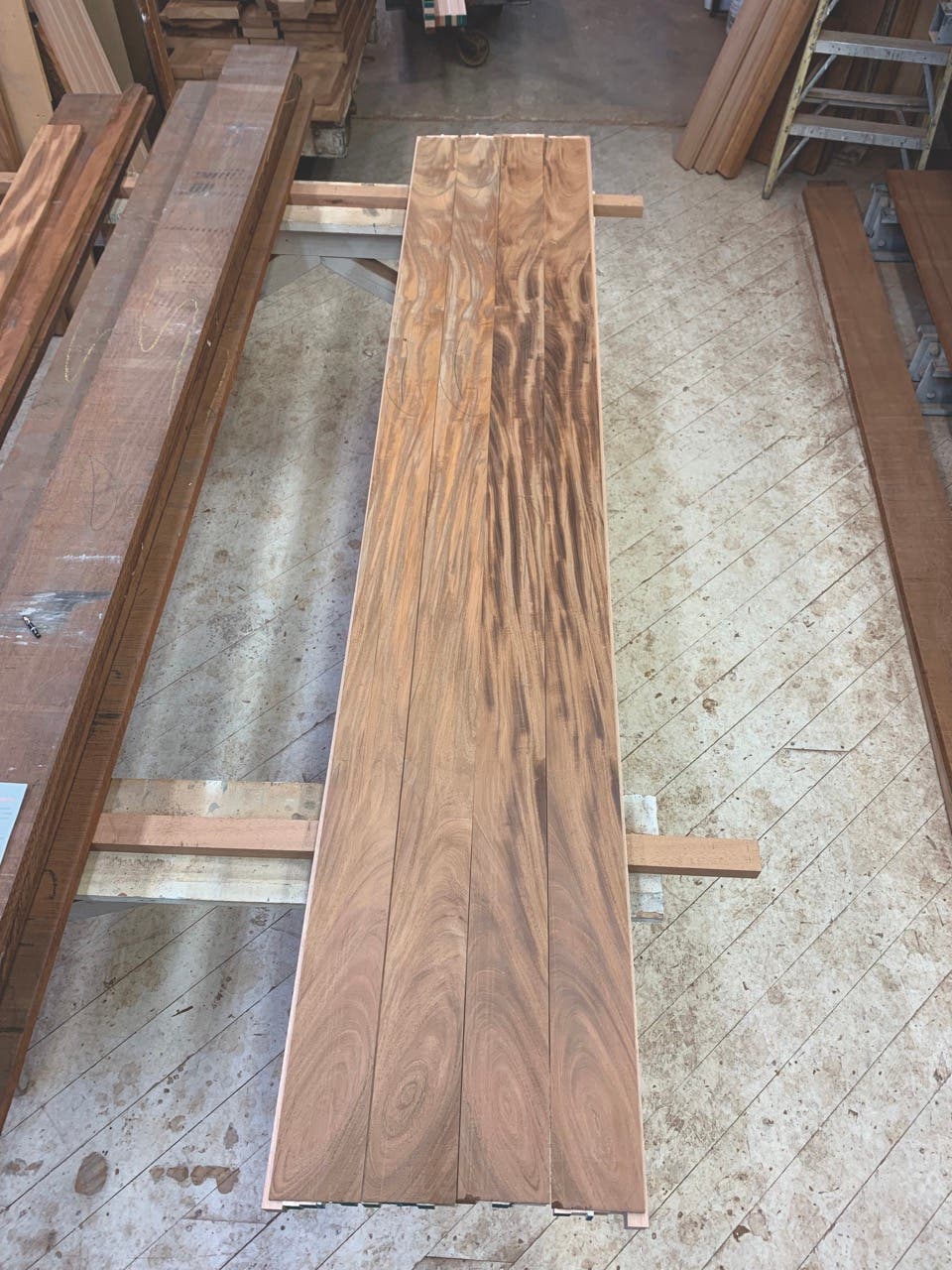
prior to assembly. Note the high contrast of the
grain/figure after the wood is machined.
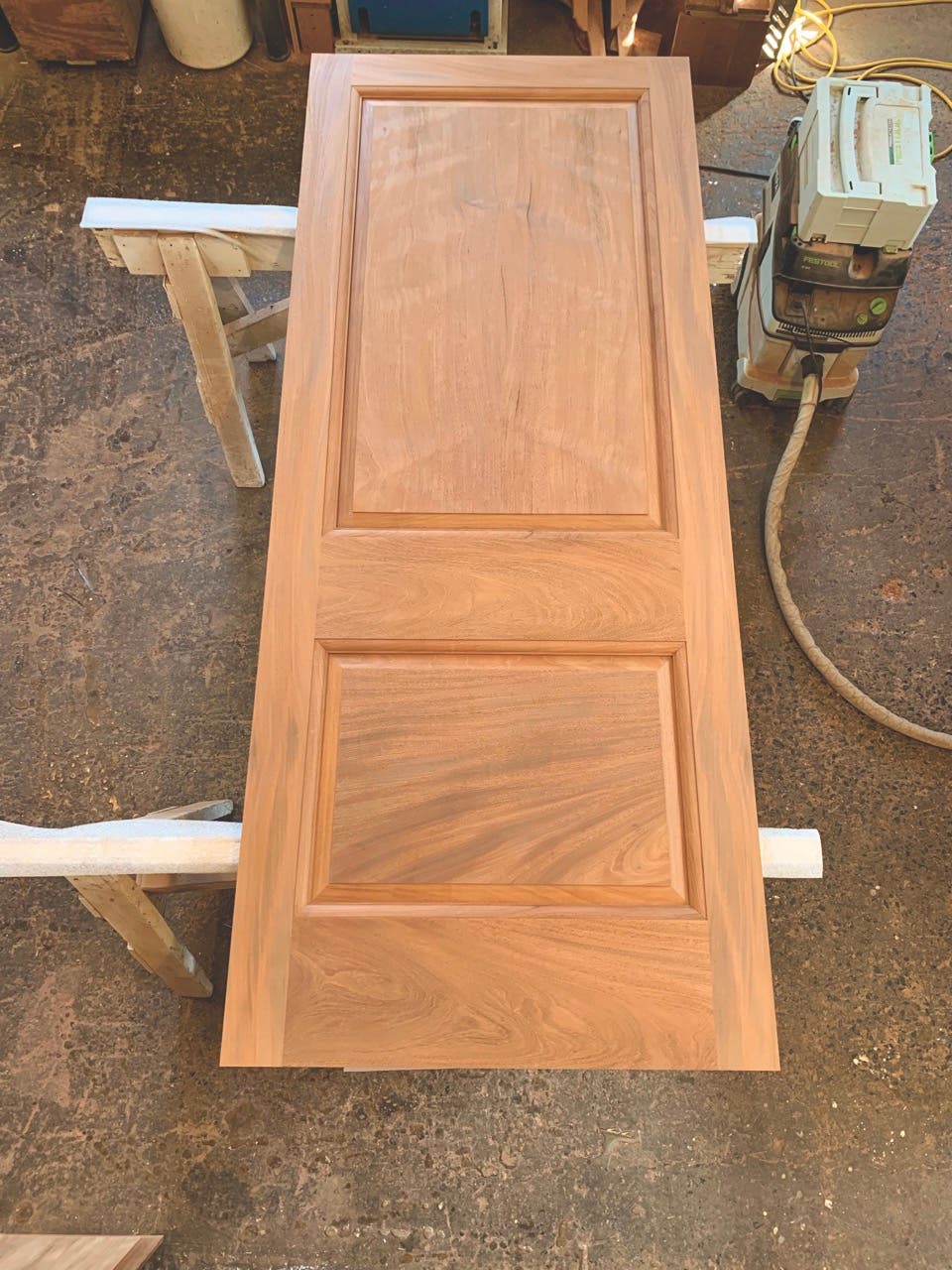
arranged for a set of double doors. Each piece was
re-sawn from the same board and arranged so the
components of each door mirror each other. Note the
directional grain contrasts differently from one side
of the board to the other.
the incredible figure found throughout.
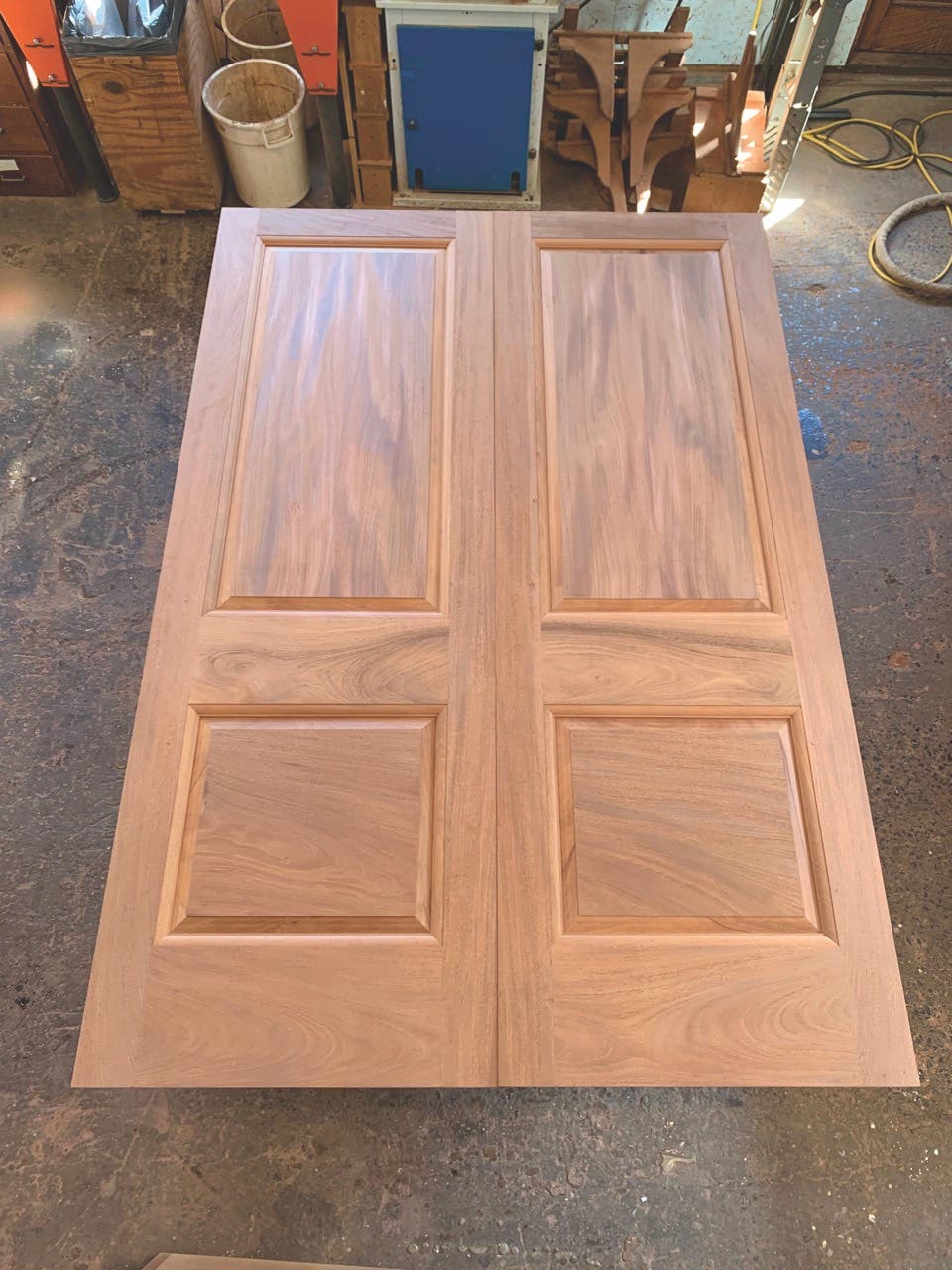
the differing elevations. Photos by Mark Hendricks
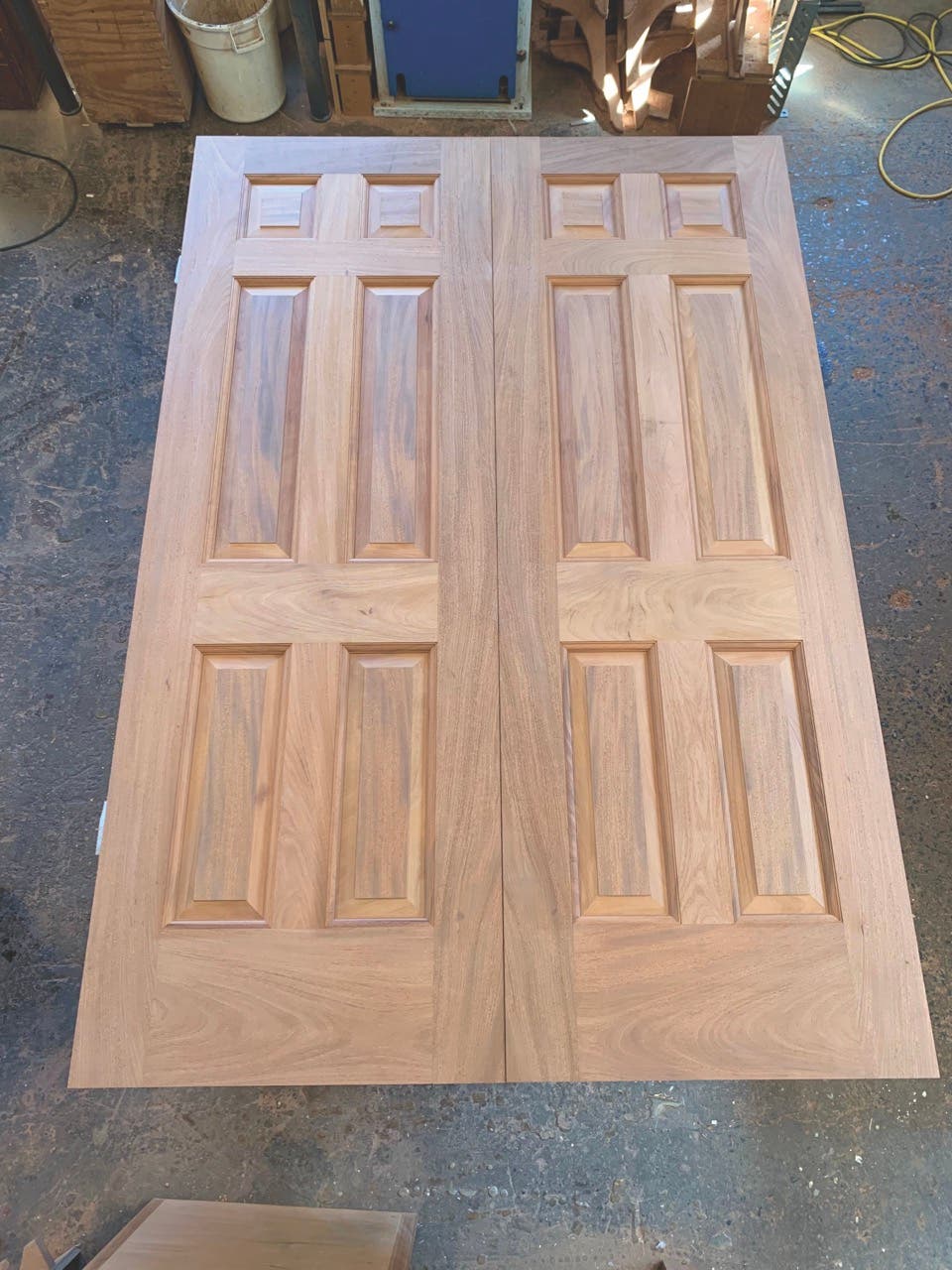
the differing elevations. Photos by Mark Hendricks
Before signing on to the project, however, Hendricks had material concerns—specifically, whether his team could source old-growth Honduran mahogany with the correct figure that matched the patterning of the original doors. His carpenter father, who founded Historic Doors, located a set of two matched 12-foot-long, two-foot-wide, two-inch-thick Honduran mahogany boards at Irion Lumber in Wellsboro, Pennsylvania. “They were from the same log, two big boards in sequence that had the same kind of figure,” Hendricks says. “My dad immediately bought those, sight unseen.”
Next, the team visited Portledge and took measurements of every profile, elevation, and detail of each surviving door. “When you have to match things at this level, the field measurement is much more intense, as you can imagine,” Hendricks says. The final designs, synthesizing those measurements into hand-sketched shop drawings, display the intricate relationship among the constituent elements of doors outfitted with, say, two panels on one side and six on the other.
“Every elevation and the details on each elevation were completely different from one side to another—the panel raise molding itself, the profile moldings that surround the panel, even the width of the stile from one side to another,” Hendricks says. Refining the design meant thinking through the nuances and divergences of both elevations simultaneously; when the bottom rail had a nine-inch face on one side and a 10-inch face on the other, for instance, it necessitated inserting a step into the top of the rail. “You couldn’t do a traditional cope and stick construction on these. All the moldings had to be applied because of the changes within the width of the frame components from one side to the next.”
Later, after procuring those first two Honduran mahogany boards, Hendricks and company “went up [to the same lumber yard], and they pulled a bunch of packs of figured mahogany off the rack, and we sorted through it by hand and pulled out all the material that we needed.” He spent several days designating a destination within the project for each piece of lumber, making decisions about orientation and grain pattern, and reconciling those choices with precedents. One original door, for instance, was bookmatched in a chevron pattern with the grain running toward the seam, while others were oriented with the grain running in the opposite direction. “It required a lot of careful thought in arranging the material in an artistic way, but also in the way that the originals had been done,” Hendricks says.
That cogitation made for a smooth, straightforward fabrication process. In the Historic Doors workshop, the team used traditional mortise and tenon joinery—the doors feature no screws, dowels, or other fasteners—while incorporating a few intentional doses of modernity, like boatbuilding epoxies and machines outfitted with custom knives to carve the profiles. “These were as close to original construction techniques without busting out hand chisels,” Hendricks says with a chuckle. The only true (and client-approved) deviation from the precedent regarded the engineered raised panel made from high-end plywood placed inside a mahogany frame with applied mahogany skin, a variation of the eighth-inch mahogany skin on the original panels. “They edge-glued the mahogany for the main structure of the panel and then applied the skin,” Hendricks says, “whereas we made a mitered frame so you don’t see end grain.”
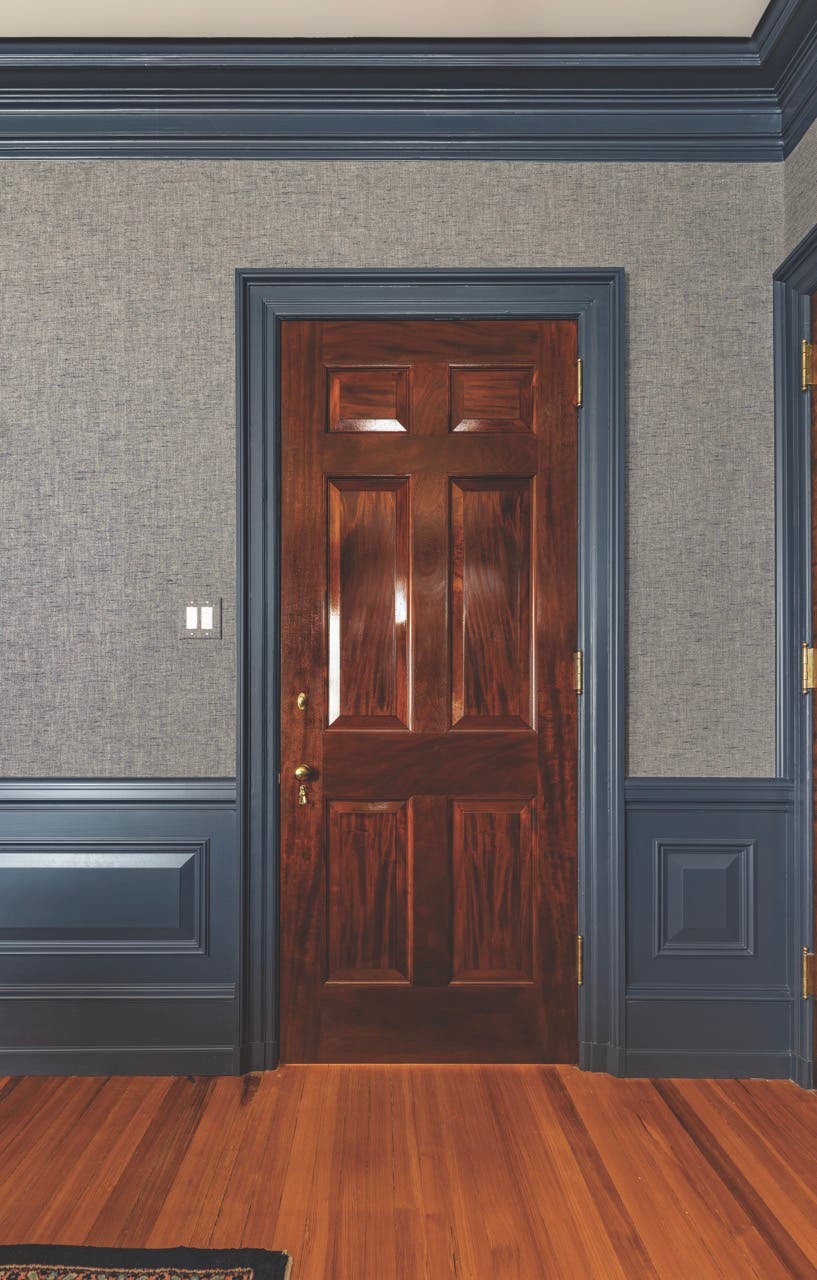
from the room side.
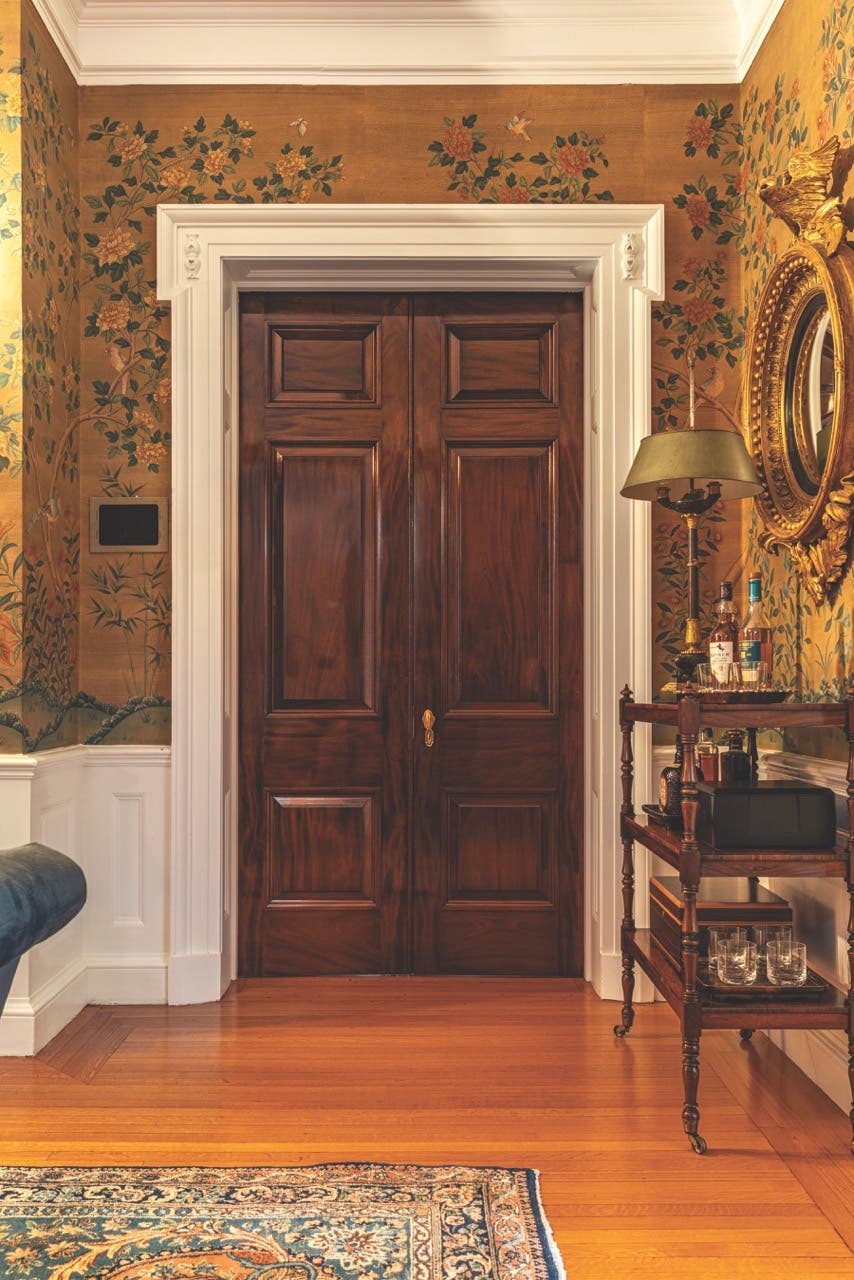
from the hallway side.
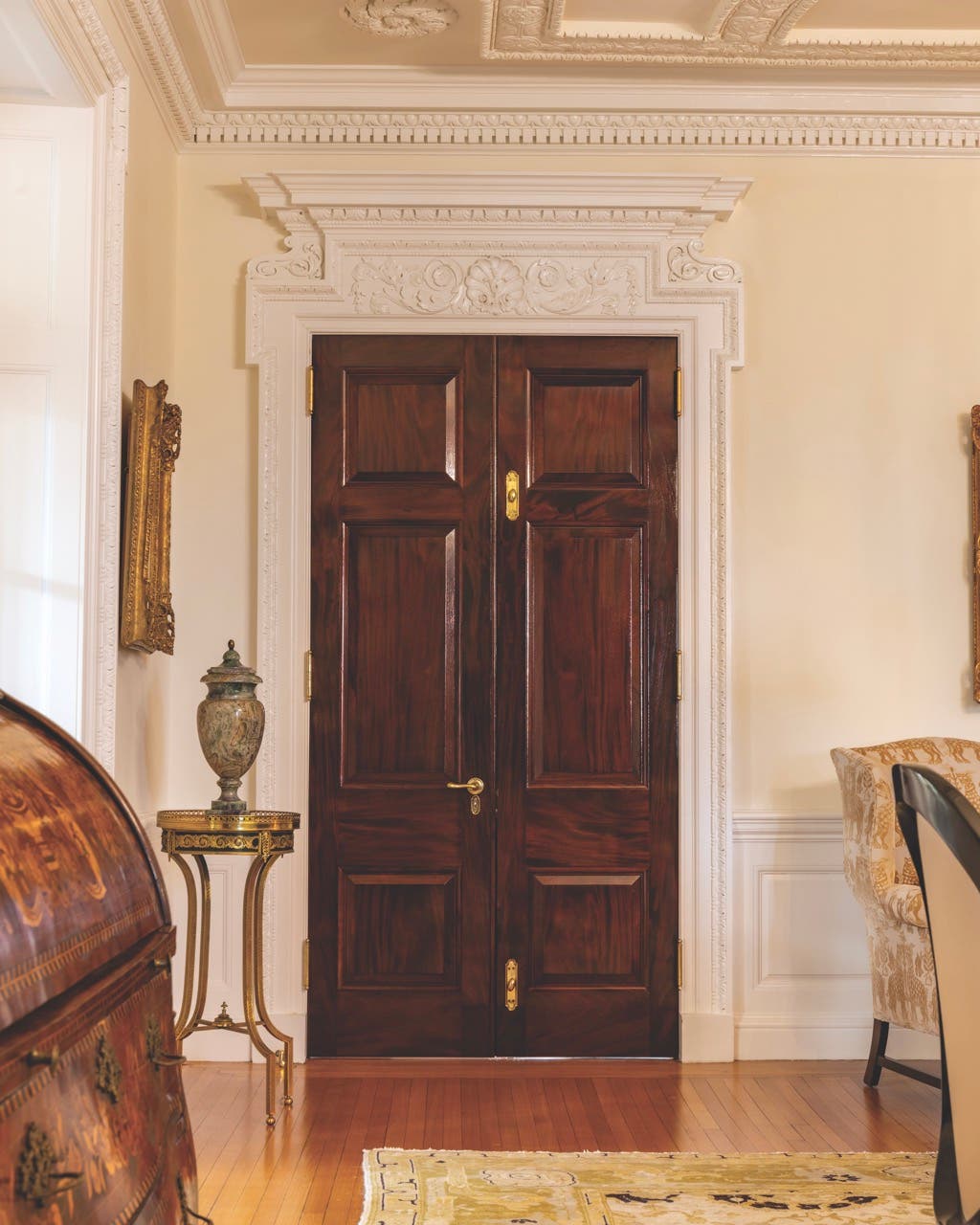
from the hallway side.
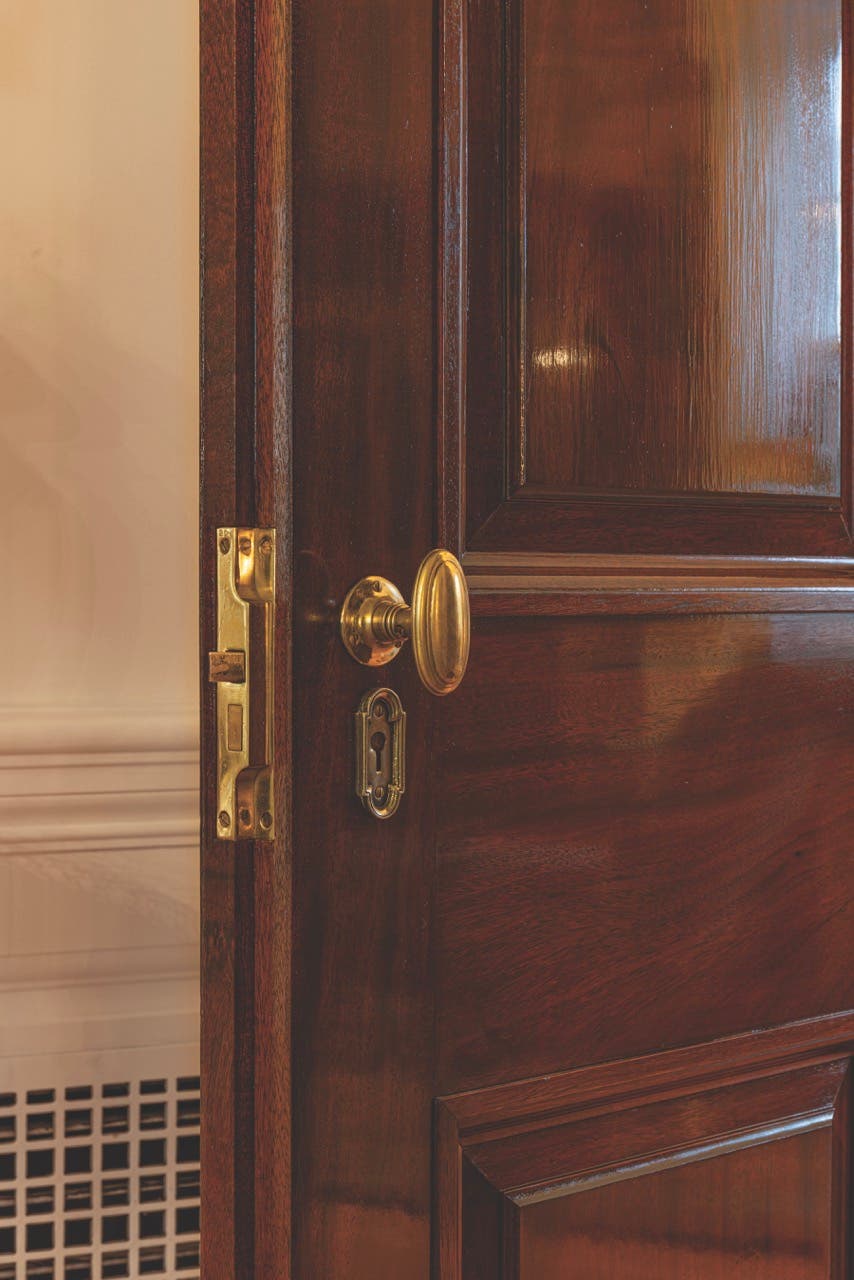
installed on the new doors. An elegant, rabbeted
mortise lock integrates seamlessly with the astragal
to the point of matching the bevel.
Photos by Giovi Photography
The finished doors are breathtaking and, at least, a little imposing. When it came time to install replica hardware, for instance, a locksmith balked when he saw the doors, prompting a furniture maker to step in and “do some pretty elaborate things” to install flush bolts equipped with oversized throws, Hendricks says. “People definitely get intimidated by stuff like this.”
From the start, the project at Portledge demanded new doors that were indistinguishable from their precursors. The mission’s success has produced a thought that lingers in Hendricks’s mind from time to time. “If I were there now,” he says, “the first thing I’d ask anyone who didn’t know the scope of the work would probably be: Which doors are original, and which ones are new?” The answer, he knows, is in the details, and even then it’s still a mystery. TB
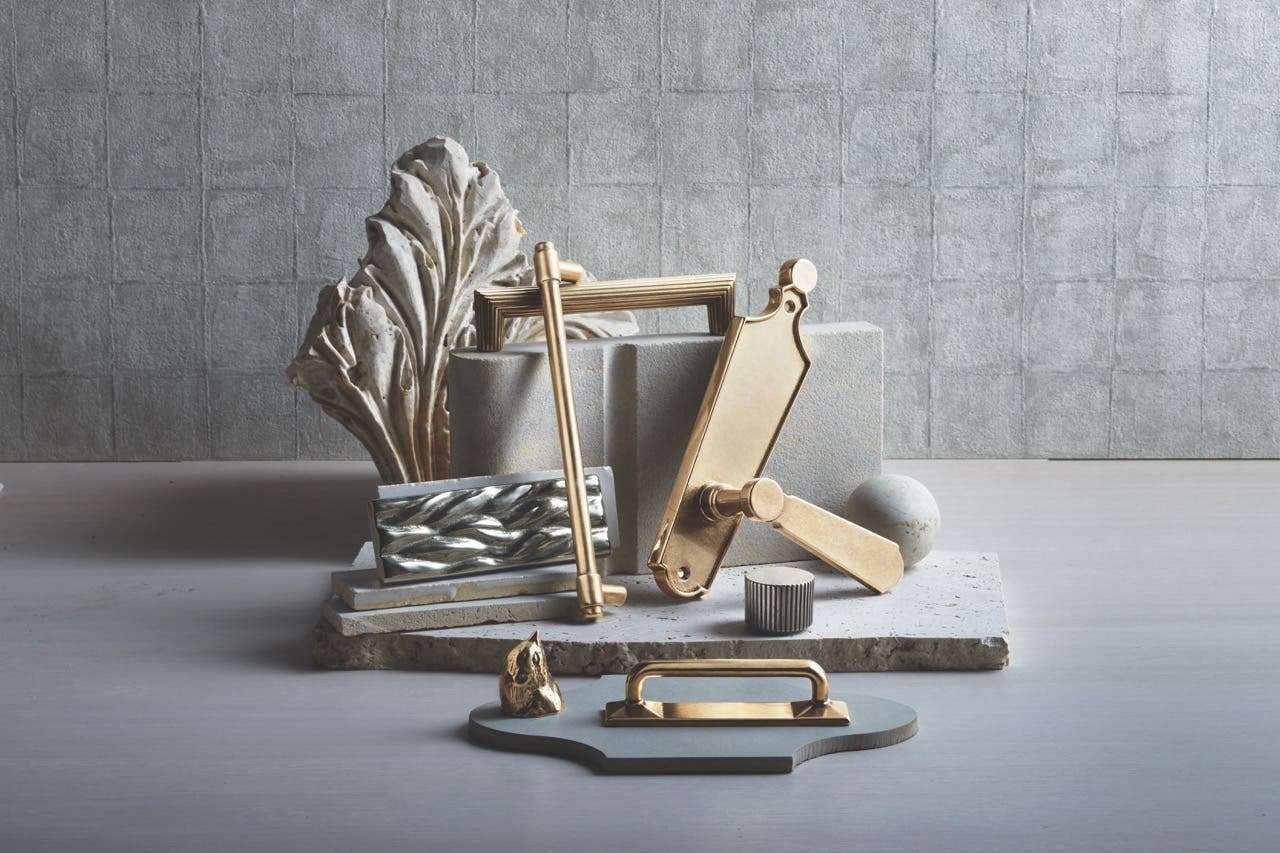
Manufacturer of handcrafted solid-bronze architectural hardware: door, window, bath, sink & cabinet hardware & kitchen accessories; 7 different finishes; traditional, contemporary & other styles.